


You searched your own business on Google.
And there they were. Your competitor. Right at the top.
And you wondered, ‘why is my competitor ranking higher on Google than me’? Maybe it’s someone you know personally. Maybe it’s a business half the size of yours. Maybe they’ve been around for five minutes and somehow they’re showing up everywhere while you’re buried on page three.
It stings. And it feels unfair.
But here’s the truth — it’s not random. Google doesn’t play favorites. It follows rules. And right now, your competitor knows those rules better than you do.
The good news? Rules can be learned. And once you know what they’re doing differently, you can do it better.
According to BrightEdge, organic search drives 53% of all website traffic. If you’re not showing up, you’re invisible to more than half your potential customers before they ever find you.
Let’s fix that.
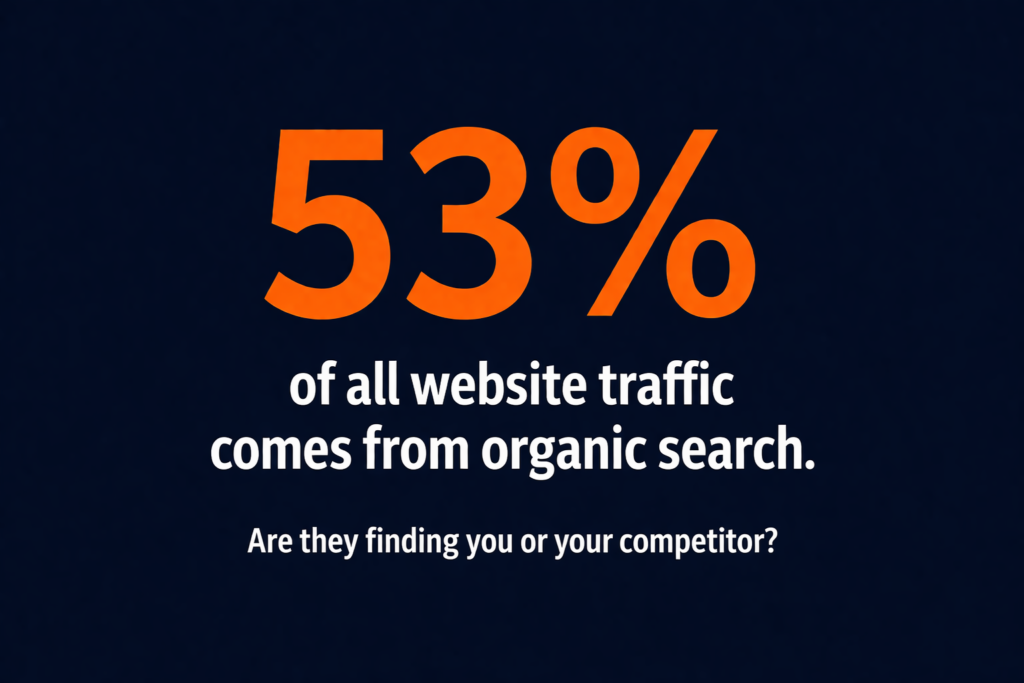
Table of Contents
What Google Is Actually Measuring
Before we get into the specific reasons, you need to understand what Google is actually doing when it decides who ranks where.
Google sends bots to crawl every website on the internet. Those bots read your pages, follow your links, and try to understand what your site is about and whether it’s trustworthy. Then Google compares your site against every other site covering the same topic and makes a judgment call about which one best answers the searcher’s question.
That judgment is based on hundreds of signals. But most small businesses are losing on the same handful of them.
Here’s exactly what those are.
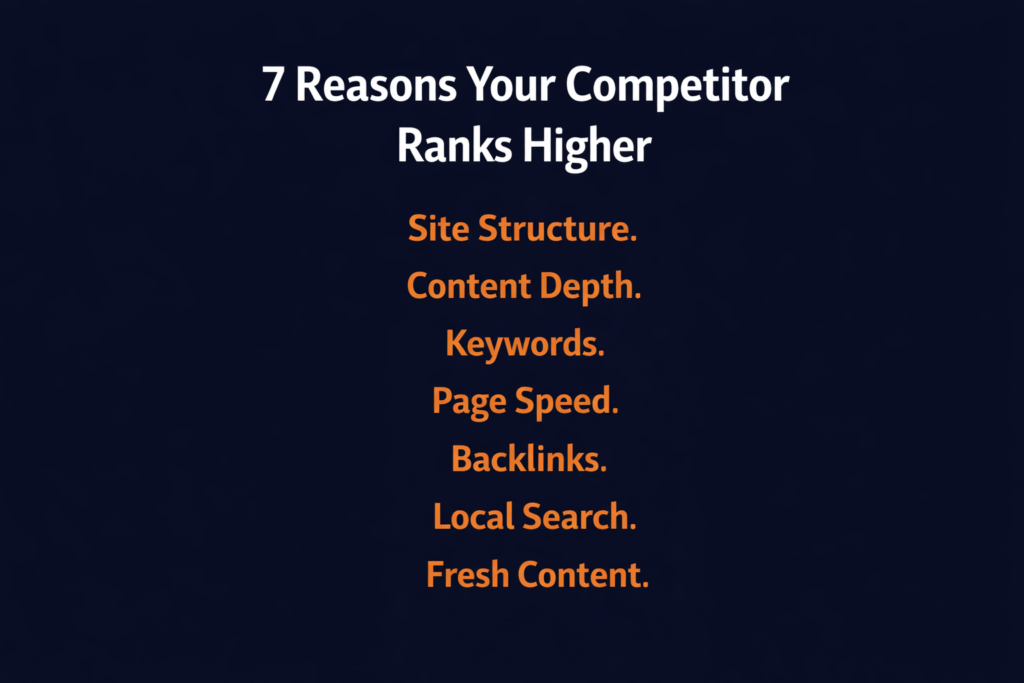
1. Their Website Structure Tells a Clearer Story
Impact: Google needs to understand what your website is about within seconds of crawling it. If your site structure is confusing — random pages, unclear hierarchy, services buried under generic navigation — Google can’t figure out what you do or who you serve. So it doesn’t rank you.
Why It Matters: Your competitor’s site probably has a clear structure. A homepage that explains exactly what they do. Service pages organized under logical categories. Blog content that supports those services. Google can follow the thread from homepage to service page to supporting content and build a complete picture of their expertise.
Real Example: HubSpot dominates search rankings across hundreds of marketing topics not because they write more content than everyone else — but because every piece of content connects to every other piece in a logical structure. Their blog posts link to their service pages. Their service pages link to related content. Google can map the entire site and understand exactly what HubSpot is an authority on.
How to Fix It:
- Organize your services into clear parent categories with sub-pages underneath
- Make sure every service page links to related blog content
- Make sure every blog post links back to the relevant service page
- Add breadcrumb navigation so Google can trace your site hierarchy
Action Items:
- Draw a simple map of your site — homepage, service pillars, sub-pages, blogs
- Identify any pages that aren’t connected to anything else — these are orphan pages and Google barely notices them
- Add internal links between related pages this week
2. Their Content Answers Questions Yours Doesn’t
Impact: Google’s entire job is to match a searcher’s question with the best possible answer. If your competitor’s page answers the question more completely than yours, they win the ranking. Every time.
Why It Matters: Most small business service pages are too thin. They say what the service is but not why it matters, how it works, who it’s for, what the process looks like, or what results to expect. That’s not an answer — that’s a brochure. Google ranks answers, not brochures.
Real Example: Zappos built its early SEO dominance not by spending more on ads but by writing more complete product pages than anyone else. While competitors had three sentences per product, Zappos had detailed descriptions, size guides, care instructions, and customer questions answered directly on the page. More complete content won more rankings.
How to Fix It:
- Every service page should be at least 800-1,000 words
- Cover what the service is, who it’s for, what the process looks like, what outcomes to expect, and common questions
- Add an FAQ section to every service page — these often get pulled directly into Google search results as rich snippets
Action Items:
- Open your top 3 service pages and count the words
- If any are under 800 words, add a process section, a who-it’s-for section, and 5 FAQ questions
- Check what questions your competitor’s page answers that yours doesn’t — then answer them better
3. They’re Targeting the Right Keywords — You’re Guessing
Impact: If your pages aren’t built around the specific words and phrases your customers actually type into Google, you won’t show up when they search — even if your service is exactly what they need.
Why It Matters: Most small businesses write their website copy the way they talk about their own services internally. But your customers don’t search the way you talk. They search the way they think. Those are often very different things.
Real Example: A law firm that optimized their pages for “legal counsel services” struggled for years while a competitor who optimized for “what to do after a car accident” dominated local search. Same service. Completely different keyword targeting. One matched how lawyers talk. One matched how customers search.
According to Ahrefs, 92% of keywords get fewer than 10 searches per month. The businesses winning search are the ones who identified the specific phrases that actually get searched — and built pages around those exact terms.
How to Fix It:
- Use a free tool like Google Search Console to see what terms people are already finding you with — then build more content around those
- Use Ubersuggest or Google’s own autocomplete to find phrases your customers actually type
- Make sure your focus keyword appears in your page title, first paragraph, at least one subheading, and your meta description
Action Items:
- Log into Google Search Console and click Performance — look at your top 10 queries
- For each service page, identify one primary keyword phrase and make sure it’s in the title, H1, and first 100 words
- Check your competitor’s page title and H1 — what keyword are they targeting that you’re not?
4. Their Pages Load Faster and Work Better on Mobile
Impact: Google officially uses page speed and mobile experience as ranking factors. A slow page or a broken mobile layout will push you down in rankings regardless of how good your content is.
Why It Matters: 63% of Google searches now happen on mobile devices according to Statista. If your site doesn’t load fast and display correctly on a phone, Google penalizes you in mobile search results — which is most searches.
Real Example: When Pinterest reduced page load times by 40% they saw a 15% increase in search engine traffic. They didn’t change a single word of content. Just made the pages faster.
How to Fix It:
- Go to PageSpeed Insights (free Google tool) and test your homepage and top service pages
- Compress any images over 200KB — large images are the most common cause of slow load times
- Make sure your site theme is mobile responsive — view every page on your phone and look for anything broken or hard to tap
Action Items:
- Run your homepage through PageSpeed Insights today — free at pagespeed.web.dev
- Identify your 3 slowest pages and compress the images on each one
- View your site on your phone and note anything that looks broken or requires zooming

5. They Have More — and Better — Backlinks
Impact: A backlink is when another website links to yours. Google treats backlinks like votes of confidence — the more quality sites that link to you, the more trustworthy and authoritative Google considers your site to be.
Why It Matters: Your competitor may have been actively building backlinks through guest posts, partnerships, directory listings, and press mentions while your site has few or none. Backlinks remain one of Google’s strongest ranking signals.
Real Example: Moz built its entire business on the back of backlink authority. By publishing original research and free tools that other sites naturally linked to, they accumulated thousands of high-quality backlinks that pushed their pages to the top of competitive marketing search terms for years.
How to Fix It:
- Get listed in legitimate business directories — Google Business Profile, Yelp, industry-specific directories
- Ask existing clients or partners if they’d be willing to link to your site from theirs
- Write one genuinely useful piece of content per month that other sites in your industry would want to reference
Action Items:
- Check your Google Business Profile is complete and verified — this is the easiest backlink you can get
- Search “[your industry] + directory” and submit your business to the top 5 results
- Use Ahrefs’ free backlink checker to see how many backlinks your top competitor has versus you
6. They’re Winning Local Search and You’re Not Showing Up
Impact: For service businesses, local search is everything. When someone searches “content marketing agency near me” or “SEO services in Seattle,” Google shows a local map pack at the top of results. If you’re not in that map pack, you’re invisible to the most ready-to-buy searchers.
Why It Matters: According to Google, 76% of people who search for something nearby on their phone visit a related business within a day. Local search intent is the highest-converting traffic you can get — and your competitor may be capturing all of it.
Real Example: A small accounting firm in Austin went from zero local visibility to the top 3 in Google Maps results in 90 days — not by spending on ads but by fully optimizing their Google Business Profile, collecting 40 new reviews, and getting listed in 12 local directories. Same services. Same website. Just better local signals.
How to Fix It:
- Fully complete your Google Business Profile — every field, every service, every photo
- Actively ask satisfied clients for Google reviews — even 10 new reviews can significantly shift your local ranking
- Make sure your business name, address, and phone number are identical everywhere they appear online
Action Items:
- Log into your Google Business Profile and complete every empty field today
- Send a review request to your last 5 clients this week
- Search your business name and check that your phone number and address are consistent across your website, GBP, and any directories
7. Their Content Is Fresh — Yours Is Stale
Impact: Google favors websites that are actively updated over websites that haven’t changed in months. If your last blog post was six months ago and your service pages haven’t been touched in a year, Google treats your site as low priority for re-crawling — which means new content takes longer to get indexed and old content slowly loses ranking. This is one answer to why is my competitor ranking higher on Google than me.
Why It Matters: Fresh content signals to Google that your site is active, relevant, and worth sending searchers to. Your competitor who publishes two blog posts a month and regularly updates their service pages is telling Google their site is alive. Yours may be telling Google the opposite.
Real Example: A marketing agency that committed to publishing one SEO-optimized blog post per week saw a 3x increase in organic traffic within six months — not because each individual post was extraordinary but because the consistent publishing cadence told Google to come back and crawl regularly.
How to Fix It:
- Publish at least one new blog post per month — consistency matters more than volume
- Update your top service pages at least once per quarter — add a new section, update statistics, refresh the copy
- When you update a page, go to Google Search Console and request indexing immediately
Action Items:
- Schedule one blog post per month for the next 3 months right now — put it in your calendar
- Pick your top 2 service pages and add one new section to each this week
- Set a quarterly reminder to review and refresh your top 5 pages
How to Close the Gap Fast
Alright — you now know exactly why your competitor is outranking you. Here’s how to close the gap without spending a fortune or rebuilding your entire site.
✅ Step 1: Audit Before You Act Before changing anything, spend 30 minutes understanding where you actually stand. Open Google Search Console, check your indexed pages, look at your top queries, and identify your biggest gaps. You can’t fix what you haven’t measured.
✅ Step 2: Fix Your Structure First Internal linking and site hierarchy are free to fix and have an immediate impact on how Google crawls and understands your site. Start here before touching content.
✅ Step 3: Expand Your Thinnest Pages Identify your service pages under 800 words and expand them first. These are your highest-value pages and they’re currently not competitive. Add process sections, FAQ sections, and outcome statements.
✅ Step 4: Target One Keyword Per Page Go through every service page and make sure it’s built around one clear keyword phrase that your customers actually search. One page, one keyword, done right beats ten pages optimized for nothing.
✅ Step 5: Build Local Signals Complete your Google Business Profile, collect reviews, and get into local directories. This is the fastest path to visible results for a local service business.
✅ Step 6: Publish Consistently One solid blog post per month. Every month. No exceptions. Over 12 months this compounds into a significant content library that builds authority, earns backlinks, and gives Google a reason to keep coming back.
The AI Search Factor in 2026
Here’s something your competitor may already know that you don’t.
Google’s AI Overviews — those AI-generated summaries that now appear at the top of many search results — are pulling content directly from well-structured, authoritative pages. If your pages are thin, poorly structured, or lacking clear answers, you won’t just miss regular search rankings. You’ll be invisible in AI search results too.
The businesses getting featured in AI Overviews in 2026 are the ones with clear page structure, complete answers, strong internal linking, and genuine expertise signals on the page. Everything we’ve covered in this post is also exactly what makes a page eligible for AI search visibility.
Fix your SEO fundamentals and you fix your AI search visibility at the same time. They’re the same thing now.
Essential Tools to Audit Your Competition
You don’t need to spend thousands to understand why your competitor is outranking you. These tools will tell you most of what you need to know:
- Google Search Console — Free. Shows exactly what queries your site appears for, which pages are indexed, and what errors exist. Start here every time.
- PageSpeed Insights — Free. Tests your page load speed on mobile and desktop and tells you exactly what to fix. Available at pagespeed.web.dev.
- Ubersuggest — Free tier available. Shows your competitor’s top keywords, their top pages, and how many backlinks they have. Invaluable for competitive research.
- Ahrefs Free Backlink Checker — Free. Paste your competitor’s URL and see exactly how many backlinks they have and where they’re coming from.
- Google Business Profile — Free. The single most important local SEO tool for any service business. If yours isn’t fully complete, that’s your first fix.
Final Thought: Your Competitor Isn’t Smarter — They’re Just More Visible
Ranking higher on Google doesn’t mean your competitor is better at what they do. It means they’ve done a better job of communicating their value to a search engine.
That’s a fixable problem.
Every reason on this list is something you can address. None of them require a massive budget. All of them require consistency, intention, and a clear strategy — which is exactly what separates the businesses showing up on page one from the ones wondering why they’re not.
Your competitor figured out the rules. Now you know them too.
The question is what you do next. It’s time to stop asking why is my competitor ranking higher on Google than me.
If you want help closing the gap faster than going it alone, our website analysis, keyword research, SEO content writing, and local SEO services are built exactly for this situation. We find what’s holding you back and fix it — so you stop watching your competitor win and start showing up where your customers are looking.
BONUS: Competitor Ranking Audit Checklist
Use this before your next strategy session:
✅ Is my site structure clear with service pages organized under logical parent pages?
✅ Are all my service pages over 800 words with complete answers?
✅ Does every page target one specific keyword phrase?
✅ Have I tested my page speed on mobile this month?
✅ Do I have more than 10 Google reviews on my Google Business Profile?
✅ Have I published a new blog post in the last 30 days?
✅ Have I updated my top service pages in the last 90 days?
✅ Are my business name, address, and phone number consistent everywhere online?
If you answered no to more than three of these — you’ve found your gap.
Frequently Asked Questions
❓ How long does it take to outrank a competitor on Google? It depends on how competitive the keyword is and how much work needs to be done on your site. For local service businesses targeting specific geographic areas, meaningful ranking improvements can happen in 60-90 days when the right fixes are made. For broader competitive terms, expect 6-12 months of consistent effort.
❓ Do I need to spend money on ads to rank higher on Google? No. Organic search rankings are earned not bought. Paid ads can put you at the top immediately but the moment you stop paying the visibility disappears. Organic rankings built on solid SEO fundamentals keep working for you around the clock without ongoing ad spend.
❓ What’s the single most important thing I can do right now to improve my Google ranking? Complete and optimize your Google Business Profile if you’re a local service business — it’s free and has the fastest visible impact. If you’re focused on organic search broadly, expanding your thinnest service pages to over 800 words with complete answers is the highest-leverage content fix you can make.
❓ Can I do this myself or do I need to hire someone? Many of the fixes in this post — internal linking, page expansion, Google Business Profile optimization, and requesting indexing in GSC — you can do yourself. The more technical elements like site structure audits, keyword research, and ongoing content strategy benefit significantly from expert guidance, especially if you want results faster than the DIY timeline.
❓ Why does my competitor rank for keywords I don’t even use on my site? Because Google doesn’t just read the exact words on your page — it understands topics, related terms, and search intent. If your competitor has more comprehensive content covering a topic in depth, Google associates their page with a broader range of related search queries. The fix is to write more complete, in-depth content that covers your topic thoroughly rather than just repeating one keyword phrase.
❓ Does social media affect my Google ranking? Not directly. Social media activity is not a confirmed Google ranking factor. However social media can drive traffic to your site, increase brand searches, and get your content in front of people who then link to it — all of which indirectly support better rankings over time.