


Your website isn’t broken. It’s just invisible. Here’s the complete guide to SEO for small business in 2026 — what it is, what’s changed with AI search, and the exact steps to start getting found by the customers who are already looking for you.
Table of Contents
Your website is live. Your services are solid. Your customers love you.
And Google has absolutely no idea you exist.
I’ve heard this from nearly every small business owner I’ve worked with. The investment in a website gets made, maybe some social media gets posted, maybe some ads get run. But the phone isn’t ringing from online searches. The leads aren’t coming in consistently. And when you Google your own services, you’re nowhere near the first page.
Here’s what I tell every client who comes to me with this problem: it’s not a technology problem. It’s a strategy problem. And it’s fixable.
SEO — search engine optimization — is the reason some small businesses show up on page one of Google while others with better services sit buried on page four. It’s not magic. It’s not luck. It’s a system. Once you understand how it works, you can use it.
If you’ve ever wondered why your competitor outranks you, or what it would actually take to show up when your best customers search for what you offer, you’re in the right place. I’m going to walk you through exactly what small business SEO looks like in 2026, what’s changed, and what you can start doing this week to turn search visibility into real leads.
Why SEO Still Matters More Than Ever for Small Business
Every year someone declares SEO dead. Every year the data proves them wrong.
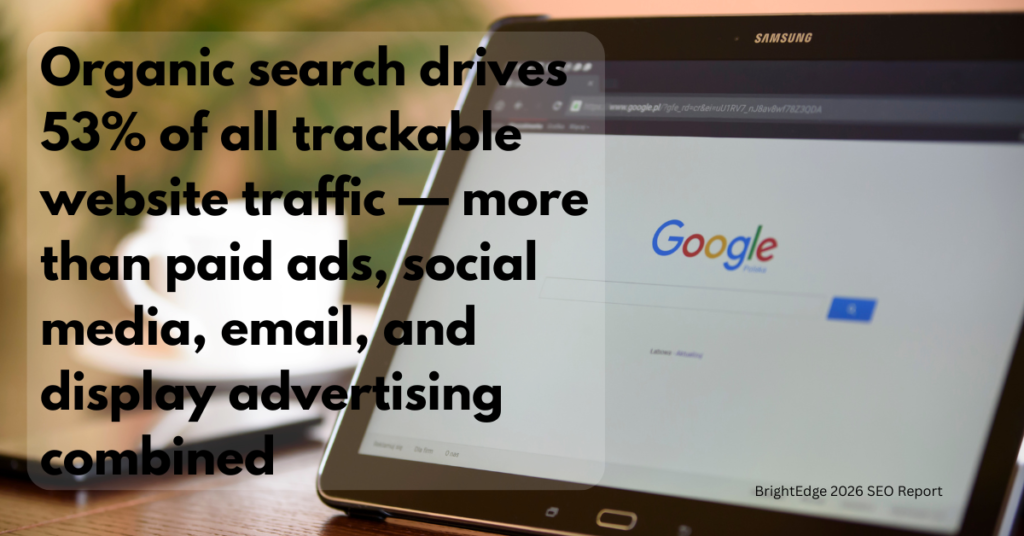
Organic search drives 53% of all trackable website traffic — more than paid ads, social media, email, and display advertising combined, according to BrightEdge. For small businesses without massive ad budgets, that number is worth sitting with. The single largest source of traffic on the internet is free, if you’ve done the work to earn it.
The opportunity is more open than most business owners realize. According to WordStream, only 39% of small businesses currently invest in SEO. That means the majority of your competitors aren’t doing this seriously. I see this constantly with clients I work with — their competitors look more established online not because they’re bigger or better, but because they’ve simply been more consistent with their SEO.
What has changed is how Google decides who wins. And that’s where a lot of businesses fall behind without realizing it.
If you want to see exactly how that gap plays out in practice, I broke down the specific reasons your competitor may be outranking you — and what to do about it — in Why Is My Competitor Ranking Higher on Google?
What SEO Actually Means in 2026
SEO used to mean stuffing the right keywords onto your pages and collecting backlinks. That era is over.
In 2026, Google evaluates your website the way a smart, skeptical customer would. It asks: Is this site trustworthy? Does this content actually answer the question being searched? Is this business a real authority on this topic? Does the page load fast and work properly on a phone?
Have you ever noticed how the top Google results for almost any search are long, thorough, well-organized pages? That’s not a coincidence. Google rewards completeness and clarity because that’s what searchers actually need.
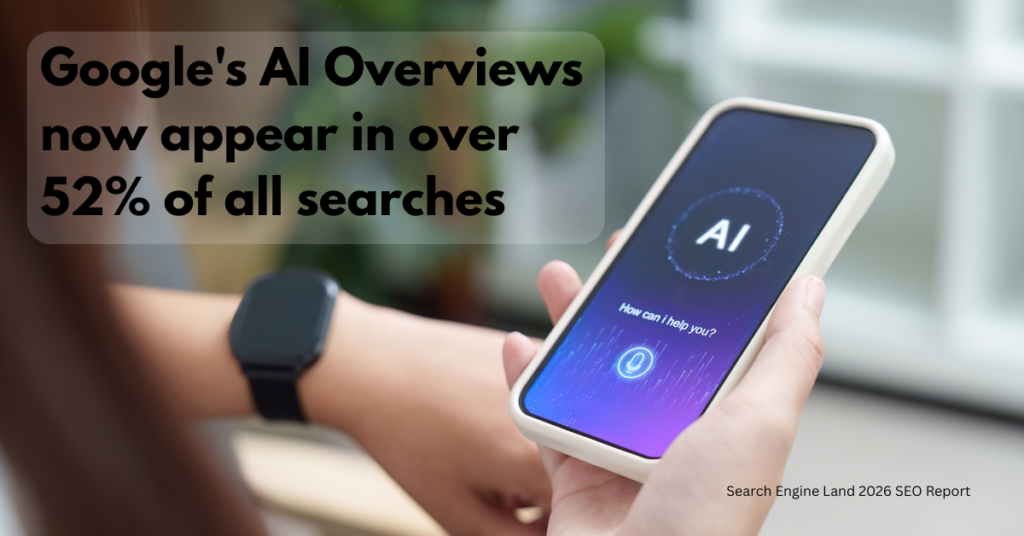
There’s also a newer layer worth understanding. Google’s AI Overviews now appear in over 52% of all searches, according to Search Engine Land. Those AI-generated summaries at the top of results pull content from well-structured, authoritative pages. The businesses showing up in those summaries aren’t necessarily the biggest or oldest. They’re the ones with the clearest, most complete, best-organized content. That’s the opening for a focused small business that’s willing to do the work right.
The 5 Pillars of SEO for Small Business
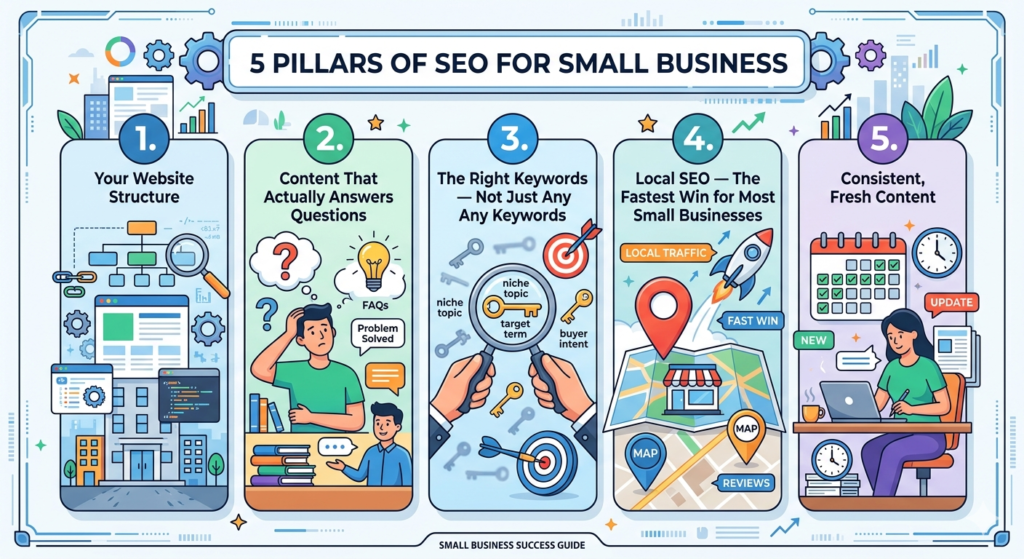
Every small business SEO strategy I’ve built comes down to five fundamentals. Miss one and you’re fighting uphill. Get all five right and search becomes your most consistent source of leads.
1. Your Website Structure
Google needs to understand what your business does within seconds of crawling your site. If your navigation is confusing, your services are buried, or your pages don’t connect to each other logically, Google can’t build a complete picture of your expertise — and it won’t rank you for much of anything. This is why SEO for small business is so important.
A clear structure means a homepage that explains exactly what you do and who you serve, individual service pages for each thing you offer, blog content that supports those services, and internal links connecting all of it together. I’ve worked with businesses that had great content living on pages that nothing else linked to. Google barely noticed those pages existed.
Fix this week: Draw a simple map of your site. Homepage at the top. Service pages beneath it. Blog posts supporting each service. Anything that doesn’t connect to anything else is an orphan page — and fixing that costs you nothing but an hour of your time.
2. Content That Actually Answers Questions
Here’s something I tell every new client: Google’s job is to match a search query with the best possible answer. If your service pages are thin — a paragraph or two about what you offer with no explanation of why it matters, who it’s for, or what results to expect — you’re not giving Google an answer. You’re giving it a brochure.
Brochures don’t rank. Answers do.
Every service page should be at least 800 to 1,000 words. Cover what the service is, who needs it, how it works, what outcomes to expect, and what questions customers commonly ask. Add an FAQ section to every service page — these frequently get pulled directly into Google search results as featured snippets, which means free visibility without even requiring a click.
Fix this week: Open your top three service pages. If any are under 800 words, add a process section, a who-it’s-for section, and five FAQ questions. That one change has moved the needle for more clients than I can count.
3. The Right Keywords — Not Just Any Keywords
Have you ever thought about how differently you talk about your business versus how your customers search for it? This is one of the most common issues I see, and it costs businesses more visibility than almost anything else.
A home services company might describe their work as “residential HVAC maintenance.” Their customer searches “why is my furnace making a noise” or “heating repair near me.” Those aren’t the same phrase — and only one of them gets found.
Keyword research means identifying the exact phrases your customers type into Google, then building your content around those phrases. One focused keyword per page, placed in your page title, your first paragraph, at least one subheading, and your meta description. That’s the basic blueprint.
If you’re just getting started with SEO and want a practical overview of the foundational steps, the SEO Quick Start Guide covers the core moves in a format you can work through right away.
Fix this week: Open Google Search Console and click Performance. Look at the top 10 queries people are already using to find your site. Build more content around what’s already working. It’s the lowest-risk place to start.
4. Local SEO — The Fastest Win for Most Small Businesses
If you serve customers in a specific area — and most small businesses do — local SEO is your highest-leverage move. According to BrightLocal, 46% of all Google searches have local intent. People are looking for businesses near them every single day, and Google shows a map pack of local results right at the top of those searches.
If you’re not in that map pack, you’re invisible to the most purchase-ready people searching in your area.
Local SEO starts with your Google Business Profile. It needs to be fully complete — every field filled in, every service category selected, photos updated, hours accurate. Then you need reviews. Even 10 to 15 genuine Google reviews can meaningfully shift your local ranking. I’ve seen businesses go from invisible to top three in local results within 60 days just by getting serious about their Google Business Profile and asking satisfied clients for reviews.
Your business name, address, and phone number also need to be identical everywhere they appear online — your website, directories, social profiles, everywhere. Even small inconsistencies send confusing signals to Google.
Fix this week: Log into your Google Business Profile and complete every empty field. Then send a review request to your last five clients. That’s two hours of work that can show results within 30 days.
5. Consistent, Fresh Content
Google favors active websites over dormant ones. If your last blog post was six months ago, Google treats your site as lower priority for re-crawling — new content indexes slowly and old content gradually loses ranking.
The fix isn’t publishing every day. It’s publishing consistently. One solid, well-optimized blog post per month tells Google your site is alive, builds topical authority over time, and creates new opportunities to rank for questions your customers are actively searching.
One of my clients committed to one blog post per month and saw their organic traffic nearly triple over 12 months. Not because any single post was extraordinary, but because the consistency told Google to keep coming back.
Fix this week: Schedule one blog post per month for the next three months. Put the dates in your calendar now. Commit to the topics. One post at a time compounds into something significant.
The AI Search Factor You Can’t Ignore
Here’s something worth paying attention to right now.
The same fundamentals that improve your Google ranking are exactly what make your content eligible to appear in AI-generated search results. Clear page structure. Complete answers. Strong internal linking. Genuine expertise on the page. This is incredibly important for SEO for small businesses.
Google’s AI Overviews pull content from well-organized, authoritative pages. If your site is thin and poorly structured, you won’t just miss traditional rankings — you’ll be invisible in AI search too. Fix your SEO foundation and you fix your AI visibility at the same time. In 2026, they’re the same strategy, not two separate ones.
For a deeper look at how Google’s AI changes are reshaping search for small businesses, I covered the biggest updates and what they mean for your visibility in Google Just Changed Search in a Big Way.

The Small Business SEO Checklist: Start Here
Run through this SEO for small business checklist before anything else. If you can’t check every box, you’ve found your first priority.
✅ My homepage clearly states what I do, who I serve, and what makes me different
✅ I have individual pages for each of my core services
✅ Every service page is at least 800 words with a complete answer covering what, who, how, and results
✅ Every service page targets one focused keyword in the title, H1, first paragraph, and meta description
✅ My Google Business Profile is fully complete and verified
✅ I have at least 10 Google reviews
✅ My business name, address, and phone number are consistent across my website and all directories
✅ I have published a new blog post in the last 30 days
✅ My top service pages link to relevant blog content
✅ My blog posts link back to the relevant service pages
If you answered no to more than three of those, you’ve found your gap. Start there.
How Long Does This Actually Take?
This is the question I get asked more than any other. And I’ll give you the same honest answer I give every client.
For local service businesses making the right fixes consistently, meaningful ranking improvements happen in 60 to 90 days. For broader competitive terms, expect 6 to 12 months of sustained effort before you’re competing at the top of page one.
What doesn’t work is doing a lot in one month and nothing the next. SEO compounds. Every piece of optimized content, every new review, every internal link you add builds on what came before it. The businesses winning search aren’t the ones who worked the hardest in January. They’re the ones who worked every month.
When to Do It Yourself vs. When to Hire a Pro
Many of the foundational fixes in this post — completing your Google Business Profile, expanding service pages, adding internal links, publishing blog posts — you can absolutely do yourself. If you have the time and you’re willing to learn, the DIY path is a real option.
But time is the catch. For most small businesses in the $500K to $10M range, the owner’s time is worth more than the cost of getting this done professionally. Every hour you spend learning keyword research is an hour not spent on the work that actually generates revenue. And the learning curve is steeper than it looks on the surface.
The companies I work with typically come to me when they’ve realized that doing it themselves is costing more than it’s saving — in missed leads, slow growth, and the mental overhead of managing something outside their expertise. If your website isn’t generating consistent leads right now, every month without a strategy is a month your competitors are capturing customers who should be yours.
For a closer look at how we approach SEO content writing for small businesses, that page walks through exactly how we build search visibility from the ground up.
Want to Know Exactly What’s Holding Your Site Back?
The first step is understanding where you actually stand with SEO for small business plan. What’s indexed, what’s ranking, what’s broken, and what’s missing.
We offer a free website content audit for small businesses ready to stop guessing and start getting found. Not a generic report — a real diagnosis of what’s limiting your search visibility and exactly what to prioritize first.
Request your free website audit today
You’ve already done the hard part — building a business worth finding. Let’s make sure Google can find it.
Frequently Asked Questions About SEO for Small Business
What is SEO for small business and why does it matter? SEO is the process of making your website visible to people searching for your services on Google. For small businesses, it matters because organic search drives more website traffic than any other channel — including paid ads — and most small business competitors aren’t doing it seriously, which creates a real competitive opening.
How long does it take for SEO for small businesses to work? For local small businesses making consistent improvements, meaningful results typically appear in 60 to 90 days. Competitive terms take 6 to 12 months of sustained effort. The key is consistency — SEO compounds over time and rewards businesses that show up every month.
How much does SEO for small businesses cost? DIY SEO costs your time. Professional SEO services for small businesses typically range from $500 to $3,000 per month depending on competition level and scope. The better question is what it costs not to invest — in leads going to competitors who rank above you every single day.
What is the difference between SEO and local SEO for small business? General SEO targets broad search terms nationally. Local SEO focuses on searches with geographic intent — near-me searches, city-specific searches, and Google Maps results. For most small service businesses, local SEO is the higher priority because it captures the most purchase-ready customers in your actual service area.
What is the most important SEO step for a small business to take first? Complete and fully optimize your Google Business Profile. It’s free, it directly impacts local search rankings, and it’s the fastest path to visible results for any business serving a local market. After that, focus on expanding your thinnest service pages to over 800 words with complete, genuinely helpful content.
Does blogging really help with SEO for small businesses? Yes — significantly. Businesses with active blogs earn 97% more backlinks than those without, according to Ahrefs. Consistent blogging builds topical authority, gives Google new content to index regularly, and creates additional pages that can rank for questions your customers are actively searching. One well-optimized post per month adds up to a powerful content library over 12 months. This is a great way to improve your SEO for small business.
Can a small business compete with large companies on Google? Yes, especially in local search. Large companies often can’t compete with a well-optimized local business for geographically specific searches. Small businesses win by going deep on local authority — complete Google Business Profiles, genuine reviews, locally focused content — in ways that national brands rarely bother to execute at the local level.
What keywords should a small business target for SEO? Start with what your customers actually search, not how you internally describe your services. Use Google Search Console to find queries already bringing people to your site, then build more content around those terms. Focus on one specific keyword phrase per page — something with clear intent that a real customer would type when ready to hire.
How does AI search affect SEO for small businesses in 2026? Google’s AI Overviews now appear in over 52% of all searches, according to Search Engine Land. Content appearing in those AI summaries comes from pages that are clearly structured, authoritatively written, and organized with clean headings and complete answers. The same SEO fundamentals that improve traditional rankings are what make your content eligible for AI search visibility.
Do I need to hire an SEO agency or can I do it myself? Many foundational fixes — Google Business Profile, page expansion, internal linking — you can handle yourself. Where professional help pays off is in keyword strategy, ongoing content production, technical SEO, and the consistency required to see compounding results. If your website isn’t generating consistent leads and you don’t have dedicated hours each week to fix it, professional help is likely the faster and more cost-effective path.