


Most small businesses are creating content. Almost none of them have a content marketing strategy.
There’s a significant difference between those two things — and it explains why so many business owners feel like they’re constantly posting, writing, and sharing without anything meaningful to show for it. The blog sits there. The social posts go out. The newsletter gets sent occasionally. And the leads? They still come from referrals and word of mouth, same as always.
I hear this constantly from the small business owners I work with. They’ve been told content marketing for small business is the answer. They’ve invested real time in it. And they’re quietly wondering if it actually works or if it’s just something marketing people say.
It works. But only when there’s a real strategy behind it.
If you’ve ever wondered what content marketing for small business is actually supposed to look like — not in theory, but in practice — you’re in the right place. I’m going to walk you through what separates content that generates leads from content that just exists, and what you can start changing today.
Table of Contents
Why Content Marketing for Small Business Matters More Than Most Owners Realize
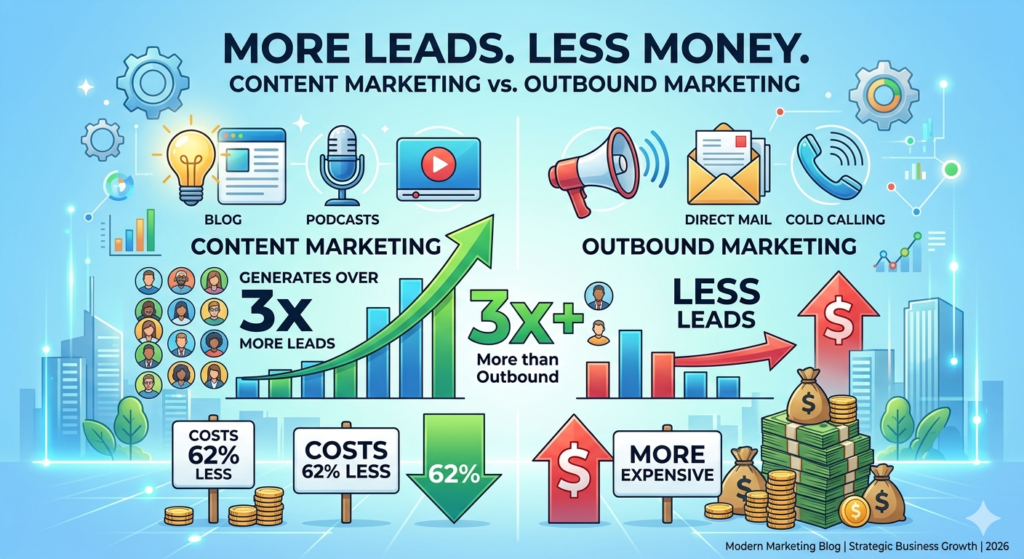
Here’s a number worth sitting with. According to Demand Metric, content marketing generates more than three times as many leads as outbound marketing and costs 62% less. More leads. Less money. For a small business with a limited marketing budget, that math changes the conversation.
The reason content marketing for small business works so well is simple: it puts you in front of your ideal customer at the exact moment they’re searching for what you offer. That’s not advertising. That’s being discovered by someone who already wants what you do.
And the compounding effect is real. A well-optimized blog post published today can generate leads 12, 24, even 36 months from now — long after the work is done. Paid ads stop working the moment you stop paying. Good content marketing for small business keeps working.
But here’s what most small businesses get wrong. They treat content marketing as a task — something to check off a list — rather than a system. They write a few posts, see no immediate results, and conclude it doesn’t work. Content marketing for small business doesn’t fail because the content is bad. It fails because there’s no strategy connecting it to actual business goals.
What Content Marketing for Small Business Actually Looks Like

Content marketing for small business is not blogging. It’s not posting on social media. It’s not writing a newsletter now and then when you have time.
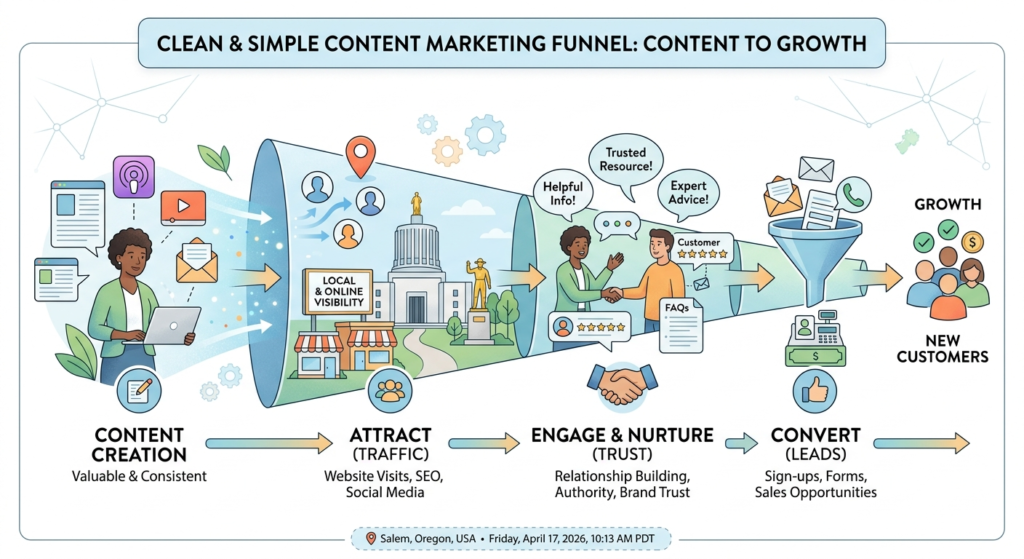
Content marketing for small business is a deliberate system of creating and distributing valuable information that attracts your ideal customer, builds trust with them over time, and guides them toward hiring you. Every piece of content should have a purpose, a target audience, and a measurable role in your lead generation process.
Have you ever landed on a blog post that answered exactly the question you were searching for — and by the end you were already thinking about contacting that company? That’s content marketing for small business working exactly the way it should. The content did the selling before anyone picked up the phone.
I work with companies in home services, healthcare, retail, and professional services. Across all of them, the ones generating consistent leads from their content share three things: they publish with intention, they optimize for search, and they connect every piece to a clear next step. The ones struggling share the opposite — they publish randomly, skip the SEO work, and end their posts with nothing that moves the reader forward.
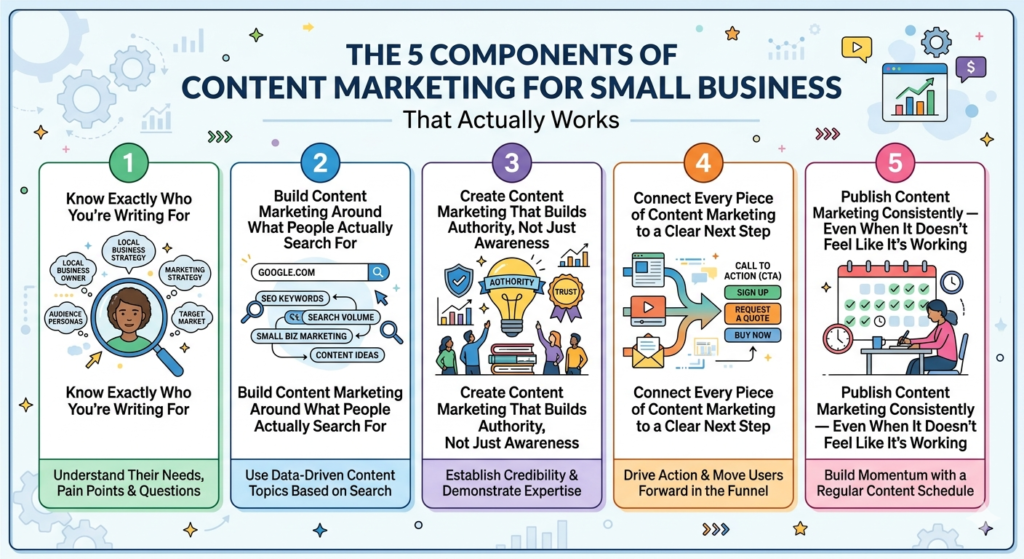
The 5 Components of Content Marketing for Small Business That Actually Works
1. Know Exactly Who You’re Writing For
The foundation of content marketing for small business is knowing precisely who you’re writing for. Content without a specific audience resonates with no one. Before writing a single word, be clear on who your ideal customer is, what they’re searching for, what questions they ask before hiring someone like you, and what would make them choose one company over another.
For most small businesses, this is simpler than it sounds. Think about your best clients. What problem were they trying to solve when they found you? What did they ask in the first conversation? What made them hesitant? Content marketing for small business starts by answering those exact questions in writing. You’re not writing for everyone — you’re writing for the person who is already looking for what you do.
Start here: Write down the top five questions your best clients asked before hiring you. Those are your first five content marketing topics.
2. Build Content Marketing Around What People Actually Search For
This is where content marketing for small business most commonly breaks down. You might write a genuinely helpful post, but if it’s not built around the phrases your customers type into Google, it will never be found. Great content that nobody discovers generates zero leads.
Keyword research doesn’t have to be complicated. Open Google and start typing a question your customer would ask. Look at the autocomplete suggestions — those are real searches happening right now. Use Google Search Console to see what queries are already bringing people to your site and build more content marketing around what’s already working.
One clear keyword phrase per piece of content. That keyword goes in your title, your first paragraph, at least one subheading, and your meta description. That’s the baseline for content marketing for small business that actually gets found.
I’ve seen clients with genuinely great insight sitting in blog posts that got zero traffic because they were never optimized for search. The fix is usually straightforward once you know what to look for. For a solid overview of how keyword research fits into your broader strategy, the SEO Quick Start Guide covers the fundamentals in plain language.
3. Create Content Marketing That Builds Authority, Not Just Awareness
Here’s a question I ask every client before we start building their content marketing for small business together: when someone reads this, will they think you’re more credible and capable than before they read it?
That’s the standard. Not “did they find it interesting.” Did it make them trust you more.
The content marketing that builds real authority is specific, opinionated, and backed by real experience. It doesn’t hedge everything with “it depends.” It takes a position, shares a genuine perspective, and demonstrates that you’ve actually solved the problem you’re writing about. Generic how-to posts don’t build authority. Specific, experience-backed content marketing for small business does.
According to the Content Marketing Institute, 87% of B2B marketers say content marketing created brand awareness for their business in the last 12 months. But awareness is the floor, not the ceiling. The goal is authority — being the business your prospect already trusts before they pick up the phone.
4. Connect Every Piece of Content Marketing to a Clear Next Step
This is the single most common mistake I see in content marketing for small business. A business owner writes a solid, helpful post. The reader gets real value from it. And then the post just ends. No next step. No call to action. No invitation to go deeper or reach out.
Your content marketing did its job. It attracted someone who needed what you offer. And then it let them walk out the door.
Every piece of content marketing for small business should end with a clear, relevant next step. Not a generic “contact us.” A specific invitation tied to what the reader just learned. If the post is about why a website isn’t generating leads, the CTA is to request a website audit. If the post covers email marketing, the CTA points to your email services. The more specific and relevant the next step, the higher the conversion rate.
Internal links matter here too. Every piece of content marketing for small business should link to at least two or three relevant service pages or related posts on your site. This keeps readers moving through your content, signals to Google that your pages are connected, and increases the chance a reader becomes a lead.
5. Publish Content Marketing Consistently — Even When It Doesn’t Feel Like It’s Working
Consistency is what separates content marketing for small business that compounds from content marketing that flatlines. According to research from Firework, businesses that blog consistently see 13 times more positive ROI than businesses that publish sporadically.
Thirteen times. Not 13% more. Thirteen times.
The reason isn’t complicated. Consistent content marketing tells Google your site is active and worth crawling regularly. It builds a library of content that earns backlinks over time. It keeps your brand visible to people in a long research phase before they’re ready to buy. And it demonstrates to potential clients that you show up — which is, in itself, a trust signal.
One solid, well-optimized post per month is enough to start building momentum with content marketing for small business. Two is better. Quality matters more than volume. A thorough, genuinely useful 1,500-word post will outperform five thin 300-word posts every single time.
If you want to see how high-performing content teams stay consistent without burning out, I broke down the specific habits that separate them in 5 Agile Secrets Top-Performing Content Teams Are Using.

The Content Types That Work Best for Small Business Content Marketing
Not all content marketing for small business serves the same purpose. Here’s how I think about it with the clients I work with.
Pillar posts are your long-form, comprehensive pieces on a core topic. These are the pages you want to rank for your most important keywords. They cover a topic in depth, link out to supporting content, and position you as the authority in your space. This post is an example of a pillar — it’s the definitive resource on content marketing for small business that everything else links back to.
Cluster posts are shorter, more focused posts that support your pillar topics. They answer specific questions, target long-tail keywords, and link back to the pillar. Together they build the kind of topical authority Google recognizes and rewards.
Evergreen content is content built to stay relevant indefinitely — how-to posts, explainers, comparison pieces, and definitive guides. This is your highest-leverage content marketing for small business investment because it keeps generating traffic and leads long after publication. To understand exactly why this matters, the post on evergreen content and long-term growth is worth reading before you plan your next piece.
Timely content covers current trends, industry changes, or recent developments. It generates spikes of traffic and signals to Google that you’re paying attention to what’s happening in your field.
For most small businesses, the priority order is: pillar posts first, evergreen clusters second, timely content as it fits.
The Small Business Content Marketing Audit: Start With What You Have
Before you write a single new piece, do this. Open your website and list every blog post and page you’ve published. For each one, ask three questions.
Is this content marketing driving any traffic? Check Google Search Console. If a post has had zero impressions in six months, it’s invisible to Google and your customers.
Is this content marketing optimized for a specific keyword? If the answer is no, it’s ranking for nothing intentionally.
Does this piece have a clear call to action? If a reader finished reading, is there an obvious next step that moves them toward hiring you?
Most small businesses I work with find that 20 to 30% of their existing content marketing is doing real work — and the rest can either be improved, consolidated, or removed. Fixing what you already have is often faster and higher-return than creating brand new content from scratch.
If you’re unsure whether your current content marketing for small business is actually good enough to compete, Is Your Content Good Enough? When to Hire a Content Marketing Agency walks through exactly what the standard should be and when it makes sense to bring in outside help.
Updating an existing post with better keywords, more depth, and a clearer CTA can move it from page four to page one in a matter of weeks. That’s content marketing for small business working smarter, not harder.
Content Marketing for Small Business and the Referral Problem
Here’s something I see constantly with small businesses that rely heavily on referrals. The referral comes in, the potential client does their research, and they go to your website. What they find there either confirms the referral was right — or creates doubt.
Your content marketing is your credibility check. A website with no blog, thin service pages, and nothing demonstrating genuine expertise tells a potential client one thing: this business doesn’t invest in its own marketing. And if they don’t invest in their own content marketing, why would they know how to help mine?
Well-executed content marketing for small business solves this problem directly. When a referred prospect lands on your site and finds deep, specific, genuinely useful content about the exact problems they’re trying to solve, the referral gets amplified. They came in warm. The content makes them hot.
For a closer look at how we approach content strategy and content creation for small businesses, that page walks through the specific frameworks we use with clients to turn content marketing into a consistent lead source.
The Content Marketing for Small Business Checklist
Work through this before you plan your next piece.
✅ I know exactly who my ideal customer is and what they search for before hiring me
✅ Every piece of content marketing I publish targets one specific keyword phrase
✅ My blog posts are at least 1,000 words with real depth, not surface-level information
✅ Every post links to at least two relevant service pages or related posts on my site
✅ Every piece of content marketing ends with a specific, relevant call to action
✅ I publish at least one new piece of content per month, consistently
✅ I have reviewed my existing content marketing and identified pieces that need updating
✅ My top-performing posts are linked from my service pages, not just sitting in the blog archive
✅ I track which content marketing is driving traffic and leads, not just page views
If you checked fewer than five of those boxes, you’ve found where your content marketing for small business needs the most attention.
Ready to Build Content Marketing That Actually Generates Leads?
Random content doesn’t compound. A content marketing system does.
The small businesses I’ve worked with that see real results aren’t necessarily publishing the most. They’re publishing with a clear strategy, optimizing every piece for search, and building a library of content marketing that works around the clock — even when they’re focused on running their business.
If your content marketing for small business isn’t generating consistent leads, the problem is almost always fixable. It starts with understanding what’s missing and building from there.
We offer a free website content audit for small businesses ready to stop guessing and start building content that converts. Not a generic report — a specific diagnosis of what’s holding your content marketing back and where the highest-return opportunities are.
Request your free content audit today
Or if you’re ready to hand content marketing off entirely, explore our blog writing and content marketing services and see how we build lead-generating content systems for small businesses from the ground up.
Frequently Asked Questions About Content Marketing for Small Business
What is content marketing for small business and how is it different from regular marketing? Content marketing for small business is the practice of creating valuable, relevant content that attracts your ideal customer rather than interrupting them with ads. Unlike traditional advertising, content marketing for small business builds trust over time by answering the questions your customers are already searching for. It’s one of the highest-ROI marketing channels available because the content keeps generating leads long after it’s published.
How long does content marketing for small business take to generate leads? Most small businesses start seeing measurable traction from content marketing within three to six months of consistent publishing. The compounding effect of content marketing for small business becomes significant at the 12-month mark, when a library of optimized content builds topical authority and consistent organic traffic. Content marketing rewards patience and penalizes inconsistency — sporadic publishing rarely compounds the way monthly consistency does.
How many blog posts does content marketing for small business require per month? One well-optimized, genuinely useful post per month is enough to start building content marketing momentum for a small business. Two to four per month accelerates results significantly. What matters more than volume is quality and consistency. Start with what you can sustain, then scale from there.
What should small business content marketing blog posts be about? Start with the questions your best clients asked before hiring you. Then look at what your customers are actively searching for using Google Search Console or autocomplete suggestions. Every piece of content marketing for small business should have a clear purpose beyond just being helpful — it should connect naturally to the services you offer and move the reader toward a next step.
Does content marketing for small business work for local companies? Absolutely, and often more effectively than for national brands. Local content marketing — posts optimized for your city or region, content addressing local market conditions, and service pages targeting geographic keywords — captures high-intent searchers who are ready to hire someone nearby. Combined with strong local SEO, content marketing for small business is one of the most powerful tools a local service company has.
What is the ROI of content marketing for small business? According to Demand Metric, content marketing for small business generates more than three times as many leads as outbound marketing at 62% lower cost. Businesses that blog consistently see 13 times more positive ROI than sporadic publishers, according to Firework. The returns compound over months and years, making content marketing for small business significantly better economics than most paid channels over time.
Should I write my own content marketing or hire someone? According to Semrush, 80% of small business owners write their own content. The advantage is authenticity and domain expertise. The disadvantage is time and inconsistency. If your content marketing for small business has been sporadic or isn’t generating traffic, working with a professional content strategist typically produces faster and more reliable results.
What makes content marketing for small business actually rank on Google? Three things working together: a clear target keyword woven naturally throughout the post, enough depth and specificity that the post genuinely answers the question better than competing pages, and internal links connecting it to related content on your site. Content marketing for small business that runs under 800 words rarely ranks competitively. Posts over 1,200 words with clear structure and proper optimization consistently outperform thinner content.
How do I know if my content marketing for small business is working? Track these four metrics: organic traffic to each post in Google Search Console, time on page in Google Analytics, leads or contact form submissions attributed to content, and keyword ranking position over time. Traffic without leads means your content marketing is attracting the wrong audience or lacks a compelling CTA. Rankings without traffic often means your title and meta description need to be more compelling in the search result itself.
What is the biggest mistake small businesses make with content marketing? Publishing content marketing without a strategy and stopping too soon. Most businesses give content marketing for small business three months, see modest results, and conclude it doesn’t work. The businesses that quit at month three would have seen meaningful results at month nine. The second biggest mistake is creating content marketing that isn’t optimized for search — great writing that nobody can find generates exactly zero leads.