

You have an email list. You’re just not using it.
That’s the reality for more small businesses than I can count. The list exists — collected from customers over the years, from a sign-up form on the website, from an old campaign that never got a follow-up. It sits there. Occasionally someone sends a promotion. Usually when revenue gets slow and the panic sets in.
That’s not email marketing for small business. That’s email guessing.
I’ve worked with business owners who were sitting on lists of 500, 1,000, even 3,000 contacts — and doing nothing with them. The moment we built an actual email marketing strategy around those lists, everything changed. Leads started coming in without running ads. Past customers started coming back. Referrals went up. All from an asset they already had.
If you’ve ever wondered whether email marketing for small business actually works — or whether it’s worth the effort for a company your size — you’re in exactly the right place. I’m going to show you what it looks like when it’s done right, why the ROI case is stronger than almost any other marketing channel, and what you can start building today.
Table of Contents
Why Email Marketing for Small Business Is the Highest-ROI Channel Available
Let’s start with a number that should change how you think about your email list.
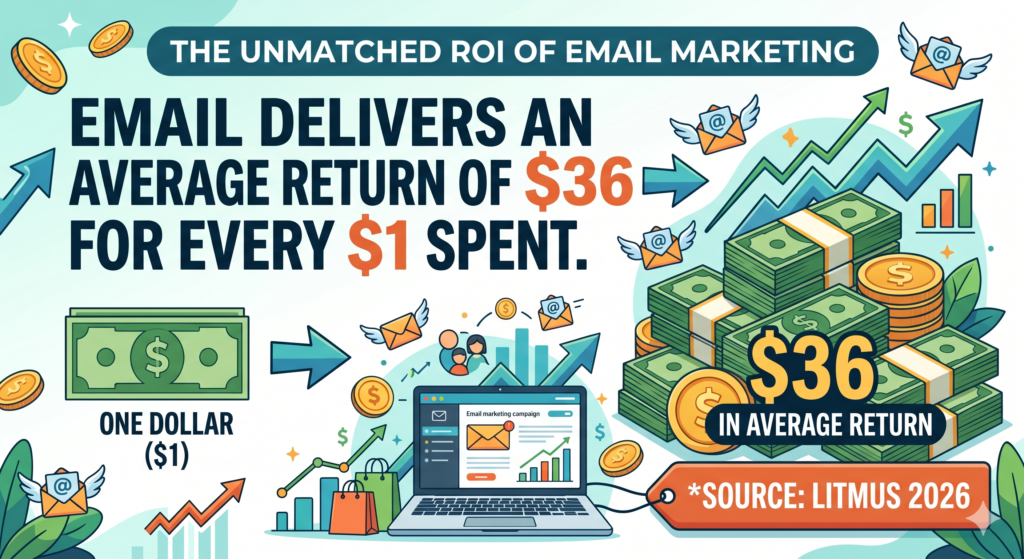
According to Litmus, email marketing delivers an average return of $36 for every $1 spent. Some industries see $42 to $45 per dollar. No other marketing channel — not social media, not paid ads, not even SEO — consistently matches that return. And according to Campaign Monitor, automated emails drive 320% more revenue than emails that aren’t automated.
For a small business with limited marketing budget, that math is the whole conversation.
Here’s why email marketing for small business outperforms every other channel. When someone is on your email list, they’ve given you direct access to their inbox. No algorithm deciding whether your message gets seen. No ad budget required to reach them again. No competing with 47 other brands in a social media feed. You reach them directly, on a channel they check — according to ZeroBounce, 88% of email users check their inbox multiple times a day.
Email is also what I call an owned channel. Social media reach is rented — platforms can change their algorithm tomorrow and your organic reach collapses overnight. Your email list belongs to you. That distinction matters more than most small business owners realize until it’s too late.
The Biggest Mistake Small Businesses Make With Email Marketing
Here’s something I see constantly, and it’s worth addressing before anything else.
Most small businesses treat email marketing for small business as a broadcast tool. They send an email when they have something to sell. A promotion, a seasonal offer, a new service announcement. And when the email doesn’t convert immediately, they conclude email marketing doesn’t work for their business.
That’s not email marketing. That’s emailing.
Effective email marketing for small business is a relationship-building system. The goal isn’t to sell in every email. The goal is to stay visible, build trust, demonstrate expertise, and be the first business your subscriber thinks of when they’re ready to buy. Some of your email subscribers are ready to hire you today. Most of them aren’t — yet. Email marketing for small business keeps you in front of the ones who aren’t ready until the day they are.
Have you ever found yourself thinking about a business you follow by email, and realizing you trust them more than competitors you’ve never heard from? That’s exactly what a good email marketing strategy does. It turns a list of contacts into a warm audience that already trusts you before they ever pick up the phone.
The 5 Components of Email Marketing for Small Business That Generates Results
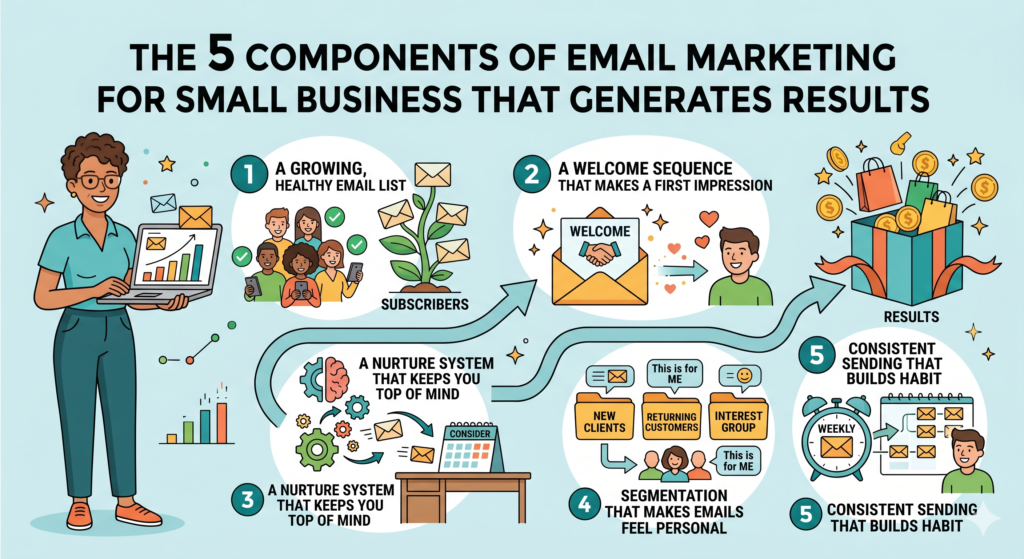
1. A Growing, Healthy Email List
Email marketing for small business starts with your list. And not just any list — a list of people who actually want to hear from you.
A lot of small businesses make the mistake of buying lists or importing old contacts who never opted in. That approach destroys deliverability, gets you flagged as spam, and burns the channel before you’ve even started. The right approach is growing a list organically — people who raise their hand and say yes, I want to hear from this business.
The most effective list-building tactics for small businesses are straightforward. A clear opt-in form on your website with a specific value proposition. A lead magnet — a checklist, a guide, a free audit — that gives someone a reason to subscribe. A simple ask at the point of sale or after you deliver a great experience. These aren’t complicated. They just need to be set up intentionally and maintained consistently.
Start here: Add one specific opt-in offer to your website homepage and your most-visited service pages. Not “subscribe to our newsletter” — that converts poorly. Instead, offer something specific like a free checklist, a mini-audit, or a quick-start guide relevant to your ideal customer.
2. A Welcome Sequence That Makes a First Impression
The most important emails you’ll ever send are the first ones. Email marketing for small business lives or dies by the welcome sequence — the automated series of emails someone receives right after they subscribe.
Here’s why this matters so much. The moment someone subscribes, their interest in you is at its highest point. They just opted in. They’re paying attention. If the first thing they receive is silence — or a generic “thanks for subscribing” email — that peak moment evaporates.
A strong welcome sequence for email marketing for small business does three things. It confirms they made the right decision by subscribing. It introduces who you are and what makes you different in a way that builds immediate credibility. And it moves them gently toward a next step — reading a key piece of content, booking a call, or exploring your services.
I’ve seen clients go from zero automated follow-up to a five-email welcome sequence and watch their lead conversion rate double within 60 days. Not from new subscribers — from people who were already on the list but had never been properly introduced to the business.
For a deeper look at what needs to be in place before you launch any email automation, the 5 Must-Do Steps Before Launching Your Email Automation post covers the critical checklist we use with every client before going live.
3. A Nurture System That Keeps You Top of Mind
Most of your email subscribers aren’t ready to buy right now. That’s not a problem — it’s an opportunity. Email marketing for small business that’s built around a nurture system stays in front of those subscribers consistently until they are ready.
A nurture sequence is a series of emails that delivers value over time. Educational content, insights from your experience, answers to common questions, behind-the-scenes perspective on how you work. Every email should make the subscriber feel like they’re getting something worth reading — not like they’re being sold to.
What does this look like in practice? A home services company might send monthly emails about seasonal maintenance tips, common mistakes homeowners make, and how to know when a repair can’t wait. A professional services firm might share case studies, answer frequently asked questions, and highlight recent results. The content is relevant, the expertise is genuine, and the brand stays top of mind until the subscriber is ready to move.
The businesses I work with that invest in a real nurture system almost universally report the same thing: when a subscriber finally does reach out, they already feel like they know you. The sales conversation is shorter. The trust is already there. That’s email marketing for small business doing its job.
4. Segmentation That Makes Emails Feel Personal
Here’s where email marketing for small business gets significantly more powerful — and where most small businesses leave serious results on the table.
Sending the same email to every subscriber is the fastest way to train your list to ignore you. Your subscribers are in different stages of their relationship with your business. Some are brand new. Some have been following you for years. Some are past clients. Some found you through search. Each group has different needs, different questions, and different reasons to open an email from you.
Segmentation means sending different emails to different groups based on where they are in their journey. New subscribers get onboarding content. Past clients get retention and referral content. Prospects who downloaded a specific resource get content directly related to that topic. The more relevant the email, the higher the open rate, the higher the click rate, and the more likely the reader is to take the next step.
According to Litmus, segmented email campaigns drive significantly higher engagement than unsegmented blasts. The technology to do this isn’t complicated — most email platforms handle it with basic tagging and list management. What it requires is intentional setup, not technical expertise.
5. Consistent Sending That Builds Habit
Email marketing for small business only works if you actually send. Consistently.
The most common failure mode I see is this: a business gets excited about email marketing, sets everything up, sends a few strong campaigns — and then life gets busy and the emails stop for two months. When they start again, the list has gone cold. Open rates drop. People forgot who you are.
Consistency builds the habit in your subscribers of opening your emails. It signals to inbox providers that you’re a legitimate sender. And it ensures that when a subscriber hits their buying moment, your email is in their inbox that week — not months ago.
For most small businesses, one email per month is the minimum. Two to four per month is better. The cadence matters less than the consistency. Pick a schedule you can maintain and stick to it. A monthly email sent every single month for 12 months builds far more value than six great emails sent sporadically.

Email Automation: Where Email Marketing for Small Business Gets Powerful
If there’s one thing I’d tell every small business owner to invest in for their email marketing strategy, it’s automation.
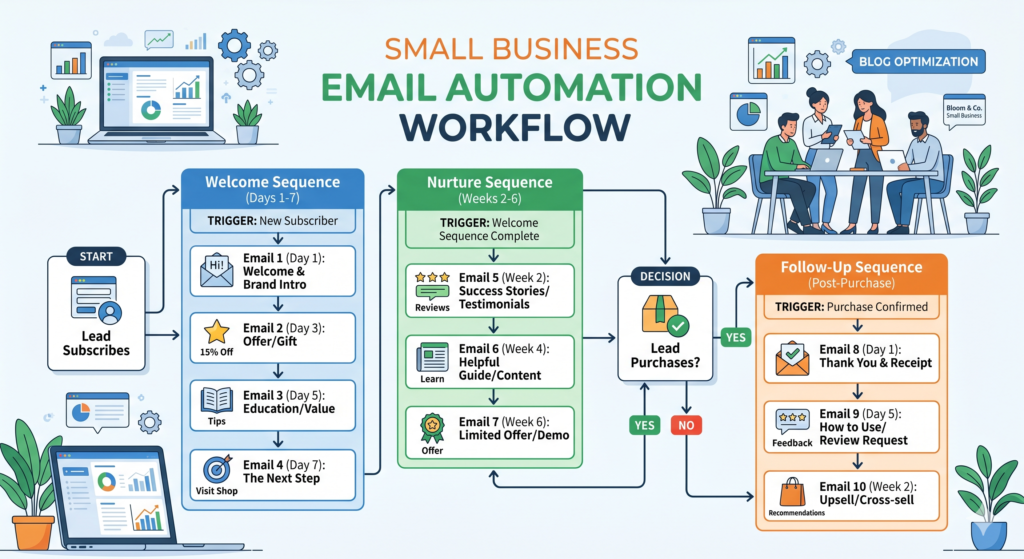
Email automation for small business means setting up emails that send themselves based on triggers — someone subscribes, someone downloads a resource, someone makes a purchase, someone hasn’t heard from you in 90 days. The email goes out at exactly the right moment without you doing anything.
The results back this up. According to Campaign Monitor, automated emails generate 320% more revenue than manual campaigns.
For a small business owner who is already stretched thin, that number tells you everything you need to know about where to spend your limited marketing time.
The most valuable automations for email marketing for small business are the welcome sequence, a post-purchase or post-project follow-up sequence, a re-engagement sequence for subscribers who’ve gone quiet, and a lead nurture sequence for prospects who haven’t yet hired you. Each of these runs in the background, working 24 hours a day, while you focus on running your business.
We walk through exactly how to build these in our email automation services page — including what each sequence should contain and how to set up the triggers that make the whole system run without manual effort.
What Good Email Marketing for Small Business Actually Looks Like
Have you ever been on an email list where you actually look forward to the emails? Where you open them because you want to, not because you accidentally clicked?
That’s the goal. And it’s more achievable than most small business owners think.
The emails that get opened and acted on share a few consistent traits. They have a specific, relevant subject line that makes the reader curious or acknowledges something they’re thinking about. They’re written in a human voice — not corporate, not salesy, not templated. They deliver something of real value — an insight, a tip, an answer, a story — before asking for anything in return. And when they do make an ask, it’s clear, specific, and directly relevant to what the email was about.
The most effective subject lines I’ve seen in email marketing for small business aren’t the ones that scream “LIMITED TIME OFFER” in all caps. They’re the ones that feel like they were written specifically for you. A question you’ve been asking yourself. A problem you’ve been sitting with. A result you didn’t think was possible. That’s the difference between an email that gets opened and one that gets deleted without a second thought.
For a full breakdown of how to write emails that actually convert, our email writing services page covers the copywriting principles behind every campaign we build.
The Email Marketing for Small Business Checklist
Work through this before your next send.
✅ My email list consists of people who actively opted in — no purchased lists
✅ New subscribers receive an automated welcome sequence within the first 24 hours
✅ I send at least one email per month, on a consistent schedule
✅ My emails deliver genuine value before making any ask
✅ I have at least one active automation running — welcome series, nurture sequence, or re-engagement
✅ My list is segmented by at least basic criteria — new vs. returning, prospect vs. client
✅ Every email has one clear, specific call to action
✅ I track open rates, click rates, and conversions — not just sends
✅ My email content reflects my brand voice and sounds like a real person wrote it
✅ I have a lead magnet or opt-in incentive that grows my list consistently
If you answered no to more than three of those, email marketing for small business is leaving real money on the table for your company.
Email Marketing for Small Business vs. Social Media: Where Should You Focus?
This is one of the most common questions I get, and the answer is more clear-cut than most people expect.
Social media is rented reach. Your followers are technically the platform’s audience, not yours. Change the algorithm, change your ad spend, get your account flagged — and your reach can disappear overnight. That’s happened to real businesses, and it will keep happening.
Email marketing for small business is owned reach. Your list is yours. Nobody can take it. No algorithm decides whether your message gets delivered. You own the relationship and the data.
That doesn’t mean social media has no value — it absolutely does for awareness and discoverability. But the businesses I work with that prioritize building their email list alongside their social presence consistently outperform those that focus on social alone. Social media brings people in. Email marketing for small business converts them and keeps them.
If you want to understand exactly why email consistently wins on ROI compared to every other channel, the post on why email marketing is still the most effective marketing tool makes the case with data.
Ready to Turn Your Email List Into a Lead Generation System?
Email marketing for small business is the highest-ROI channel available. It’s also the one most small businesses underuse, undervalue, and underinvest in — which means the opportunity right now is significant.
The businesses winning with email aren’t the ones with the biggest lists. They’re the ones with a real strategy, a consistent sending schedule, and automation running in the background converting subscribers into clients around the clock.
If your email list is sitting unused — or your current email marketing isn’t generating consistent results — I’d like to take a look at what’s missing.
We offer a free website content audit that covers your email marketing setup alongside your content and SEO strategy. No generic report — a specific diagnosis of what’s holding your email marketing back and what to build first.
Or if you’re ready to build an email system from the ground up, explore our full email marketing services for small business and see exactly how we build lead-generating email systems that run while you focus on your business.
Frequently Asked Questions About Email Marketing for Small Business
What is email marketing for small business and why does it matter? Email marketing for small business is the practice of building a list of subscribers — customers, prospects, and leads — and communicating with them consistently through email to build trust, deliver value, and drive purchases or inquiries. It matters because email marketing for small business delivers an average return of $36 for every $1 spent, making it the highest-ROI marketing channel available to businesses of any size.
How do I build an email list for my small business? Email marketing for small business list growth starts with giving people a specific reason to subscribe. Add a clear opt-in form to your website with a lead magnet — a checklist, guide, or free resource relevant to your ideal customer. Ask satisfied clients to join your list after a positive experience. Include a sign-up invitation in your email signature, social profiles, and any proposals or onboarding materials you send. Consistent, organic growth beats a purchased list every single time.
How often should a small business send marketing emails? For most small businesses, email marketing frequency should be at minimum once per month and ideally two to four times per month. Consistency matters more than volume — a monthly email sent every month for a year builds far more audience trust than a burst of weekly emails followed by two months of silence. Start with a frequency you can maintain, and build from there.
What should small business marketing emails include? Email marketing for small business works best when emails deliver genuine value before making any ask. Educational content, answers to common questions, insights from your experience, relevant tips, and client stories all perform well. Every email should have one clear call to action — not five competing ones. And every email should sound like it was written by a real person who cares about the reader, not a marketing department trying to hit a quota.
What is email automation and does my small business need it? Email automation for small business means setting up email sequences that send automatically based on subscriber behavior — signing up, downloading a resource, making a purchase, or going quiet for a period of time. You set it up once, and it runs continuously. According to Campaign Monitor, automated emails generate 320% more revenue than manual campaigns. Every small business that does any volume of leads or clients benefits from at least a basic welcome sequence and a lead nurture automation.
How does email marketing for small business compare to social media? Email marketing for small business consistently outperforms social media on ROI, conversion rate, and audience ownership. Email drives an average conversion rate of 4.24% compared to social media’s 0.59%, according to WSI. More importantly, your email list is an asset you own — social media followers are technically the platform’s audience, subject to algorithm changes that can eliminate your reach overnight. Both channels have a role, but email marketing for small business is the foundation, not a secondary tactic.
What is the ROI of email marketing for small business? According to Litmus, email marketing delivers an average return of $36 for every $1 spent. Some industries see $42 to $45 per dollar. That makes email marketing for small business the highest-ROI digital marketing channel consistently available — significantly outperforming paid ads, social media, and even SEO in direct revenue attribution. The return compounds over time as your list grows and your automation system matures.
How do I write email subject lines that get opened? The best subject lines for email marketing for small business are specific, relevant, and written from the reader’s perspective. They acknowledge a problem the reader has, ask a question they’re already asking themselves, or offer something specific and valuable. Avoid vague subject lines like “Our Monthly Newsletter” and generic urgency like “Don’t Miss Out!” The subject lines that consistently get the best open rates feel like they were written specifically for the person reading them — because effectively, they were.
Should I hire someone to manage email marketing for my small business? If your email marketing for small business currently consists of occasional one-off campaigns with no automation, no consistent schedule, and no clear strategy, professional help will almost certainly produce a faster and higher return than DIY. The setup work — building automations, writing sequences, segmenting lists, establishing sending cadence — takes significant time and expertise. Once the system is built correctly, the ongoing return is substantial. Many small businesses find that a professionally built email system pays for itself within the first 90 days.
What email marketing platform is best for small business? The best email marketing platform for small business is the one that fits your current list size, integrates with your existing tools, and offers the automation features you need without overwhelming complexity. Popular options for small businesses include Mailchimp, Klaviyo, ActiveCampaign, and ConvertKit. The platform matters less than the strategy built on top of it — a sophisticated platform with a weak email strategy will still underperform a simpler platform with a well-built nurture system behind it.