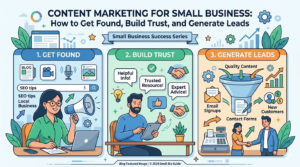


More than two-thirds of small businesses increased their marketing budgets in 2026. Fewer than one in five feel confident the money is working.
That gap between spending and confidence is one of the most common problems I see with small business marketing strategy. The budget goes up. The tactics multiply. And the results stay frustratingly unpredictable. Not because the business isn’t good. Not because the market isn’t there. But because there’s no cohesive strategy connecting the spending to the outcomes.
I’ve worked with small business owners who were running ads, posting on social, sending the occasional email blast, and publishing a blog post every few months, all disconnected from each other, none of it building toward anything. When I ask what their small business marketing strategy is, most of them describe a list of tactics. That’s not a strategy. That’s a to-do list.
If you’ve ever felt like you’re spending on marketing but not sure what’s actually working or if you’re ready to stop guessing and start building something that compounds you’re in the right place. I’m going to walk you through what a real small business marketing strategy looks like, what it costs, and what to prioritize first.
Why Most Small Business Marketing Strategy Fails Before It Starts
Here’s a truth that’s uncomfortable but important. According to LocaliQ’s 2026 Small Business Marketing Trends Report, 73% of small businesses lack confidence in their marketing strategies. Nearly three quarters.
That’s not a budget problem. That’s a strategy problem.
The most common failure mode I see is what I call tactical marketing. Choosing channels before defining goals, running campaigns before the conversion foundation is in place, and measuring results by activity rather than outcomes. Posting on social media because it feels like marketing. Running a promotion because it’s something to do. Adding a new channel because someone mentioned it at a conference.
A genuine small business marketing strategy starts somewhere completely different. It starts with clarity on who you serve, what problem you solve better than anyone else in your market, and what specific outcome you’re trying to drive. Everything else builds from there.
What a Real Small Business Marketing Strategy Actually Looks Like
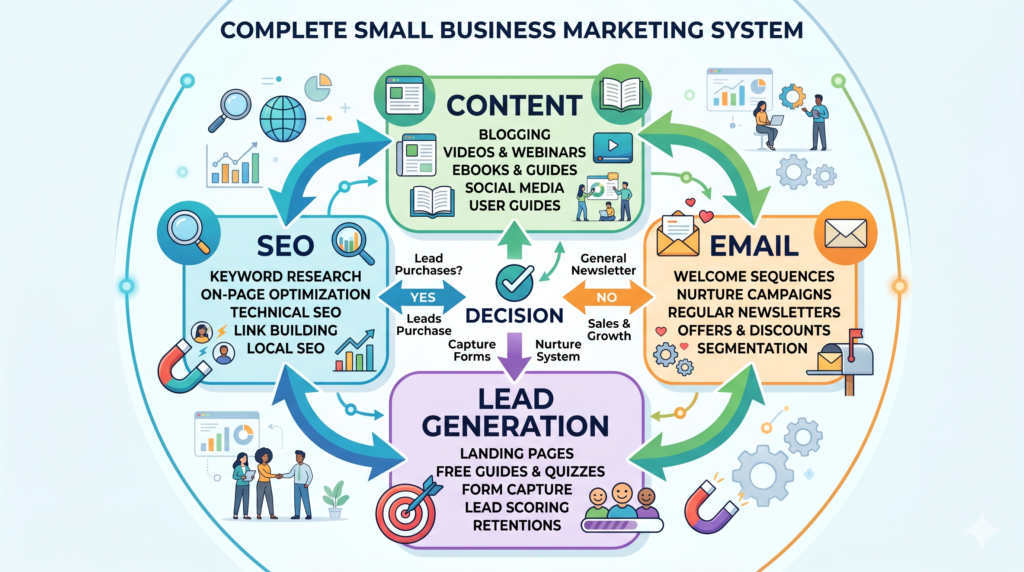
Think of your small business marketing strategy as a system with four interconnected layers, each one building on the one before it.
The first layer is visibility: getting found by the right people. This is your SEO, your local search presence, and your content marketing working together to put you in front of people who are already looking for what you offer. For a deeper look at how search visibility fits into your overall strategy, the SEO for small business pillar post covers the full search foundation.
The second layer is credibility: giving people a reason to trust you once they find you. This is your website, your content, your reviews, and your authority signals doing the work of convincing a visitor that you’re the right choice before they ever reach out.
The third layer is conversion: making it easy for the right people to take the next step. This is your calls to action, your contact forms, your landing pages, and your lead capture working together to turn visitors into inquiries.
The fourth layer is nurture: staying in front of people who aren’t ready yet and keeping past clients engaged. This is where email marketing and systematic follow-up do the compounding work that keeps your pipeline full even in slow months.
Most small businesses have pieces of this in place. Almost none of them have all four layers connected and working together. That’s the gap a real small business marketing strategy closes.
The 5 Fundamentals of Small Business Marketing Strategy That Produce Results
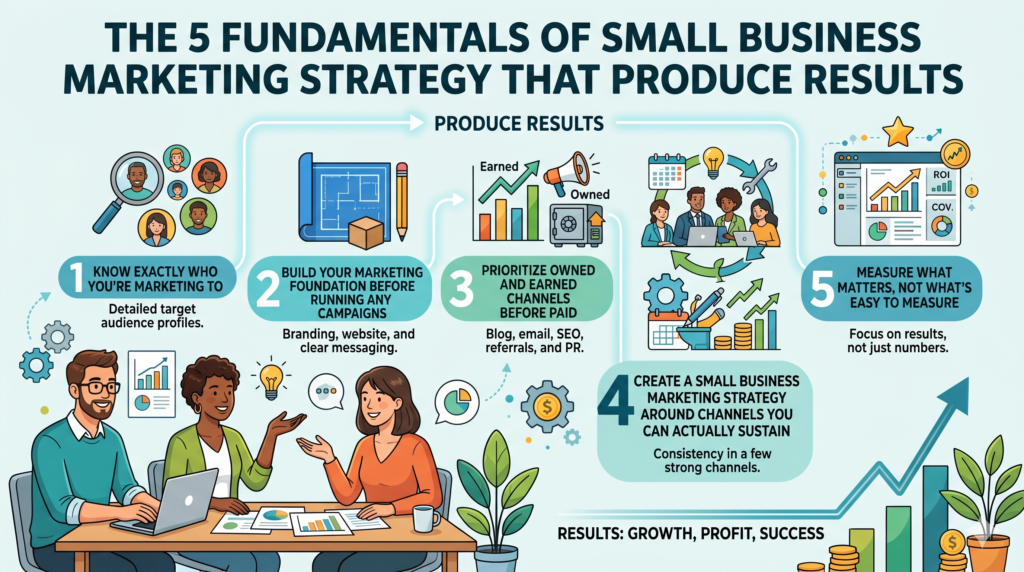
1. Know Exactly Who You’re Marketing To
Have you ever read a piece of marketing so generic it could have been written for literally any business? That’s what happens when a small business marketing strategy doesn’t start with a clear picture of the ideal customer.
Your ideal customer isn’t everyone. It’s the specific type of person or business that gets the most value from what you offer, is willing and able to pay for it, and is the most likely to refer others. Every marketing decision — which channels to use, what content to create, how to write your homepage, how to position your pricing — flows from knowing who that person is with precision.
I ask every new client the same question: describe your three best clients from the last two years. The answers always paint a clearer picture of the ideal customer than any demographic profile could. Those clients share something. They came in through a specific channel. They had a specific problem. They responded to a specific message. Build your small business marketing strategy around replicating that pattern, and everything becomes more efficient.
2. Build Your Marketing Foundation Before Running Any Campaigns
One of the most expensive mistakes in small business marketing strategy is running campaigns before the foundation is in place. This is the equivalent of sending a thousand people to a restaurant with no tables, no menu, and no kitchen staff. The traffic means nothing if the destination isn’t ready to convert it.
Your marketing foundation includes your website structured around your ideal customer’s needs, service pages that do real selling work, a Google Business Profile that’s fully built out, a clear and consistent brand message across every touchpoint, and a follow-up process that responds to new inquiries the same day.
Before you spend a dollar on ads or a significant amount of time on content, audit these fundamentals. If they’re not in place, that’s where your time and money produce the highest return. I’ve seen clients eliminate entire ad campaigns after fixing their website because the organic and referral traffic they already had started converting at a rate that made the ads unnecessary.
3. Prioritize Owned and Earned Channels Before Paid
Here’s a small business marketing strategy principle that goes against what most ad platforms want you to believe: paid advertising should amplify what’s already working, not substitute for what isn’t built yet.
Owned channels (your website, your content, your email list) produce compounding returns. They keep working after you stop actively investing in them. An optimized blog post from 18 months ago still generates leads today. An email list you’ve been building for two years contacts every month at essentially zero marginal cost. Those assets belong to you.
Paid channels including Google Ads, social media ads, display advertising stop the moment you stop paying. They can generate leads quickly, and there’s a place for them in a mature small business marketing strategy. But they’re volatile in a way that owned channels aren’t. The businesses I work with that achieve the most durable growth invest in their owned channels first and use paid to accelerate what’s already working.
According to the U.S. Small Business Administration, businesses with revenues under $5 million should allocate 7 to 8% of gross revenue to marketing. For a business doing $1 million in revenue, that’s roughly $5,800 to $6,700 per month. The question is how to allocate that across channels intelligently — and the answer almost always starts with SEO, content, and email before paid ads.
4. Create a Small Business Marketing Strategy Around Channels You Can Actually Sustain
This is where a lot of small business marketing strategy advice breaks down. The recommendation is to be on every channel — blog, social media, email, YouTube, podcast, paid ads — and for most small businesses, trying to do all of that is the fastest path to doing none of it well.
The most effective small business marketing strategy I’ve seen is one built around two to three channels executed consistently and well, rather than six channels executed poorly and sporadically. Consistency matters more than volume. A business that publishes one excellent blog post per month and sends a genuine email to its list every two weeks will outperform one that publishes three posts in January, nothing in February, and a random social campaign in March.
Pick the channels where your ideal customer actually is. For most local service businesses, that’s Google search and email — with content marketing feeding both. For B2B professional services, LinkedIn and email tend to outperform. For home services, Google search and local visibility are non-negotiable. Start there. Add channels only when the ones you’re already on are working consistently.
5. Measure What Matters, Not What’s Easy to Measure
Here’s a question I ask clients who tell me their marketing isn’t working: what specifically isn’t working, and how do you know?
Most of the time, the answer reveals that they’ve been measuring activity — posts published, ads running, emails sent — rather than outcomes. Actual leads generated. Conversion rates by channel. Cost to acquire a client. Revenue attributed to marketing. Those are the numbers that tell you whether your small business marketing strategy is working.
A healthy small business marketing strategy aims for at minimum a 5:1 return — five dollars back for every dollar invested in marketing. A 10:1 return is exceptional and achievable for businesses with strong owned channel foundations. If you’re below 3:1 and can’t explain why, the problem is either in your channel mix, your conversion process, or both.
What to track: organic traffic by month, leads by source, contact form submissions, call volume attributed to website and content, email open and click rates, and revenue closed that can be traced back to a marketing touchpoint. You don’t need enterprise analytics to do this. A simple spreadsheet updated monthly is enough to start seeing patterns.
How Much Should a Small Business Spend on Marketing?
This is the question I get asked most often, and it deserves a direct answer.
The U.S. Small Business Administration recommends 7 to 8% of gross revenue for businesses under $5 million in annual revenue.
Research from TrueFuture Media found that businesses with less than $10 million in revenue actually allocate an average of 15.6% of their marketing budgets — higher than the SBA benchmark — because smaller businesses need to invest more to build awareness and market share that larger companies already have.
For a small business doing $500,000 annually, that’s roughly $2,900 to $4,000 per month at the SBA benchmark. For a business at $2 million, that’s $11,600 to $13,300 per month. Those numbers aren’t arbitrary — they reflect what it actually takes to compete in digital search, produce consistent content, and maintain a presence that generates leads reliably.
What I tell clients who feel like those numbers are too high: the real cost of underinvesting in marketing is the revenue you don’t generate. The leads that went to a competitor with better visibility. The referrals that didn’t materialize because your online presence didn’t reinforce the word of mouth. Marketing isn’t a cost center — it’s how your business grows. Treating it like an expense rather than an investment is the single most common reason small businesses plateau.

When DIY Marketing Stops Making Sense
Most small business owners start by doing their own marketing. That makes complete sense — budget is limited, nobody knows the business better than you do, and there’s real value in understanding how each channel works before handing it off.
But there’s a point where DIY marketing stops being efficient. I work with businesses at the inflection point — where they’ve grown enough that their time is worth more than the cost of professional marketing, but not so large that they have an in-house team. For most businesses, that inflection point comes somewhere between $500,000 and $2 million in annual revenue.
The signs I look for: marketing is being done inconsistently because the owner is too busy, the website and content haven’t been updated in six months or more, leads are coming primarily from referrals with little or nothing coming from search, and there’s no clear picture of what channels are working and why. When those things are true simultaneously, the cost of doing nothing outweighs the cost of getting professional help.
The post on when it’s time to hire a marketing agency goes deeper on this decision — including what to look for in an agency and what questions to ask before signing anything.
Paid Ads vs. Organic Marketing: What a Good Small Business Marketing Strategy Gets Right
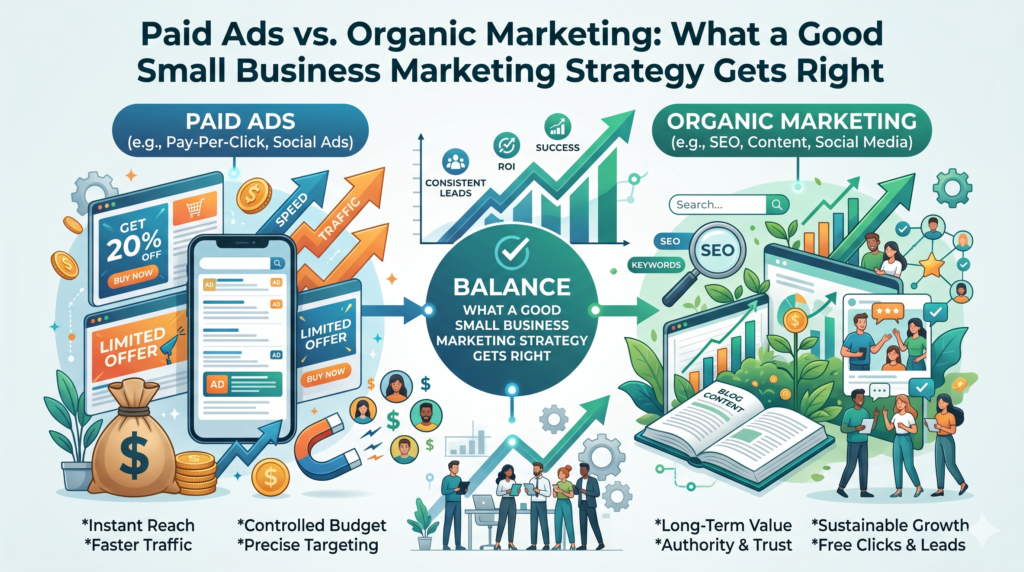
Here’s the honest answer to one of the most debated questions in small business marketing strategy.
Paid ads work. They generate leads faster than organic channels and can be scaled up or down based on budget. For businesses with a well-converting website and a proven offer, Google Ads and social media advertising are powerful tools.
But paid ads are not a small business marketing strategy. They’re a tactic inside a strategy. And they have a fundamental limitation: the moment you stop paying, the leads stop. You own nothing at the end of a paid campaign. No content asset that keeps ranking. No email list that keeps engaging. No authority that compounds over time.
Organic marketing — SEO, content, email — builds assets you own. It takes longer to produce results, but those results compound and persist. A business that invests in organic channels consistently over 12 months has a materially stronger marketing position than one that spent the same money on ads — because the organic assets are still working, while the ads are gone the moment the budget stopped.
The right small business marketing strategy uses both, in the right order: organic first to build the foundation and own the asset, paid second to amplify what’s already converting. If you’re running paid ads before your organic foundation is solid, you’re renting results instead of building equity.
For a look at how we approach digital marketing strategy and content for small businesses specifically, that page walks through the framework we use to prioritize channels and build a sustainable marketing system.
The Small Business Marketing Strategy Checklist
Work through this before adding any new channel, campaign, or spend.
✅ I can clearly describe my ideal customer — who they are, what problem they have, and what they search for
✅ My website homepage answers what I do, who I serve, and what to do next — clearly and quickly
✅ My service pages are thorough, keyword-optimized, and end with a specific call to action
✅ My Google Business Profile is fully complete, verified, and has at least 10 reviews
✅ I publish at least one piece of new content per month, consistently
✅ I have an active email list and send to it at minimum once per month
✅ I have a follow-up process that responds to new inquiries within the same business day
✅ I know which channels are generating my leads and what it costs to acquire a client
✅ My marketing budget is at least 7% of gross revenue and allocated primarily to owned channels
✅ I have a clear next step I’m offering to visitors, subscribers, and referrals at every touchpoint
If you checked fewer than six of those boxes, your small business marketing strategy has gaps that are likely costing you leads every single month.
Ready to Build a Small Business Marketing Strategy That Actually Produces Results?
A small business marketing strategy that works isn’t complicated. But it does require the right fundamentals in the right order, connected and working together as a system rather than a collection of disconnected tactics.
The businesses I work with that see the most consistent growth share a common thread — they stopped chasing tactics and started building a strategy. They know who they’re marketing to, they’ve built their foundation before spending on ads, and they measure outcomes instead of activity. The result is marketing that compounds over time and produces leads reliably, not just when they’re actively pushing a campaign.
If you’re not sure where your small business marketing strategy is breaking down, the fastest way to find out is an honest audit of what you have and what’s missing.
We offer a free website content audit for small businesses ready to stop guessing. Not a generic checklist — a real diagnosis of what’s holding your marketing back and what to prioritize first.
Request your free strategy audit today
Or explore how our full range of digital marketing services for small business — from SEO and content to email and lead generation — work together to build the kind of marketing system that produces compounding, predictable results.
Frequently Asked Questions About Small Business Marketing Strategy
What is a small business marketing strategy and why does every business need one?
A small business marketing strategy is a documented plan that defines who you’re trying to reach, what channels you’ll use to reach them, what you want them to do, and how you’ll measure whether it’s working. Without one, marketing becomes a series of disconnected tactics that rarely compound or build toward a clear outcome. A small business marketing strategy turns spending into investment by connecting every channel and campaign to a specific, measurable business goal.
What is the most effective small business marketing strategy in 2026?
The most effective small business marketing strategy combines a strong organic foundation — SEO, content marketing, and email — with a website built to convert, and a systematic lead follow-up process. For local service businesses, this is paired with a fully optimized Google Business Profile and consistent local visibility. Paid advertising plays a supporting role once the foundation is in place. The businesses seeing the strongest results are those that treat marketing as a connected system, not a collection of individual campaigns.
How much should a small business spend on marketing?
The U.S. Small Business Administration recommends allocating 7 to 8% of gross revenue to marketing for businesses under $5 million in annual revenue. Research suggests businesses under $10 million often invest closer to 15% of their marketing budget in practice. The right number depends on your growth goals, competitive landscape, and how established your marketing foundation already is. New businesses building from scratch typically need to invest more as a percentage of revenue than established businesses with strong organic traffic and referral networks.
What is the biggest mistake small businesses make with their marketing strategy?
Running tactics without a strategy. This means choosing channels before defining goals, spending on ads before the website converts, and measuring activity — posts published, emails sent — instead of outcomes — leads generated, revenue attributed, cost per acquisition. The second biggest mistake is inconsistency — bursts of marketing activity followed by months of nothing, which prevents any channel from building momentum or compounding results over time.
Should a small business do its own marketing or hire a professional?
Many small business owners successfully manage their own marketing in the early stages. The inflection point to professional help typically comes when the business has grown enough that the owner’s time is worth more than the cost of outsourcing, but the marketing results are inconsistent or unclear. Common signs it’s time to hire: leads come primarily from referrals with nothing from search, the website hasn’t been updated in six months, marketing is being skipped because other priorities take over, and there’s no clear picture of which channels are working and why.
What is the difference between a marketing strategy and a marketing plan?
A small business marketing strategy defines the why and the who — your target audience, your positioning, your channels, and your goals. A marketing plan defines the how and the when — the specific campaigns, content pieces, budgets, and timelines that execute the strategy. You need the strategy first. Without it, the plan has no direction and the tactics have no purpose.
How long does it take for a small business marketing strategy to produce results?
Timeline depends on which channels you prioritize. Content marketing and SEO build momentum over 3 to 6 months and produce compounding returns at the 12-month mark. Email marketing typically shows results within 30 to 60 days once a proper system is in place. Paid advertising can generate leads immediately but requires a converting website underneath to be cost-effective. Most small businesses see meaningful improvement in lead quality and volume within 90 days when they fix their marketing foundation first and execute their strategy consistently.
How do I know which marketing channels are right for my small business?
Start with where your ideal customer already is and what they do when they’re ready to hire someone like you. For most local service businesses, that’s Google search — which means SEO and Google Business Profile are non-negotiable starting points. Email is high-ROI for almost every business type because it nurtures existing relationships. Social media works best as a visibility and trust layer rather than a primary lead source for most service businesses. Choose two to three channels you can execute consistently, prove they work, then add more.
What does a complete small business marketing strategy include?
A complete small business marketing strategy includes a clear definition of your ideal customer, a strong website and content foundation, search visibility through SEO and local search optimization, a consistent content marketing cadence, an email marketing system that builds and nurtures your list, a lead capture and follow-up process, and a measurement framework that tracks outcomes rather than activity. Each of these elements reinforces the others — and the combination produces results that no single tactic achieves on its own.
What is the ROI of a good small business marketing strategy?
A healthy small business marketing strategy should aim for at minimum a 5:1 return — five dollars back for every dollar invested. According to data compiled by Crestmont Capital, businesses that achieve this benchmark typically have strong owned channel foundations paired with a converting website. Email marketing delivers an average $36 to $42 per $1 spent according to Litmus. SEO-focused content marketing can deliver 748% ROI over three years according to FirstPageSage. The compounding nature of owned channels means the return typically increases significantly in years two and three of consistent investment.