
Most small businesses don’t have a lead generation problem. They have a lead generation system problem.
There’s a difference. A lead generation problem means nobody wants what you offer. A lead generation system problem means people are looking for exactly what you offer — and your website, your content, and your follow-up process aren’t set up to capture them when they show up.
That second problem is almost always what I find when I start working with a new client. The business is solid. The reputation is good. The referrals are there. But online? The website sits there looking fine while potential leads quietly leave and find a competitor who made it easier to take the next step.
If you’ve ever looked at your website traffic and wondered why more of those visitors aren’t turning into inquiries — you’re in the right place. Lead generation for small business is a system, not a tactic. I’m going to walk you through exactly what that system looks like and what you can start fixing today.
Table of Contents
Why Lead Generation for Small Business Is a System, Not a Campaign
Here’s the most common mistake I see with lead generation for small business: treating it like a one-time event. Run an ad. Send an email blast. Post on social media. Wait. Repeat when revenue slows down.
That’s not a system. That’s panic marketing. And it produces inconsistent results at best.
A lead generation system for small business is a set of connected elements that work together continuously — pulling people in through search and content, moving them through a clear process on your website, capturing their information or inquiry, and following up in a way that converts interest into a conversation. When it’s built correctly, it runs around the clock without you manually driving every piece of it.
The data backs this up. According to HubSpot, brands with an active blog generate 68% more leads than those without one.
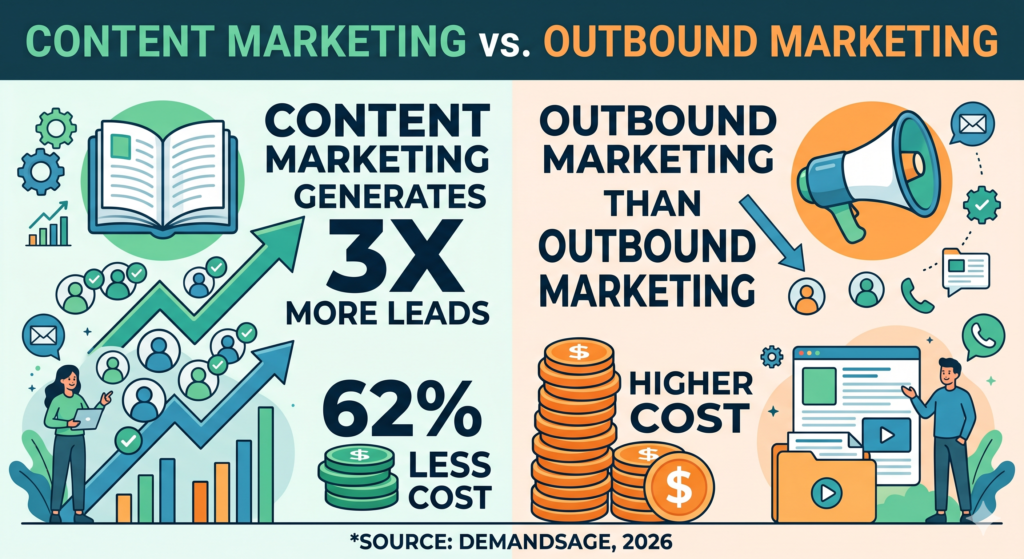
And according to DemandSage, content marketing generates three times more leads than outbound marketing at 62% less cost. The businesses winning at lead generation for small business aren’t necessarily running more ads. They’ve built a smarter system underneath the ads.
The 5 Elements of Lead Generation for Small Business That Actually Work
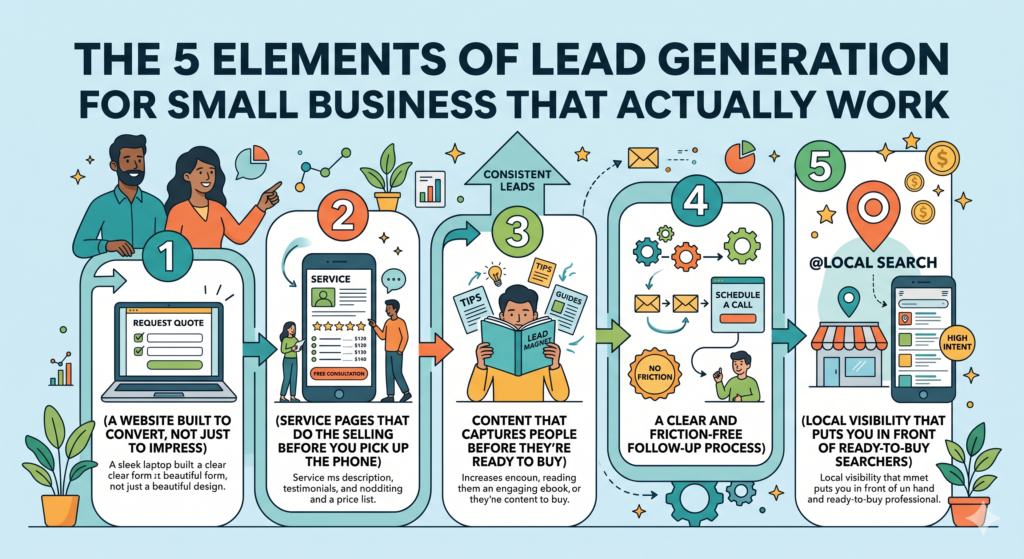
1. A Website Built to Convert, Not Just to Impress
Your website is the center of your lead generation for small business system. Everything else — SEO, content, ads, social media, referrals — sends people there. What happens when they arrive determines whether you get a lead or lose one.
Have you ever landed on a business website and spent 30 seconds trying to figure out what they actually do? Or found yourself looking for a phone number that was buried somewhere in a footer? That’s a website built to exist, not to convert. And it’s one of the most common lead generation problems I diagnose.
A website built for lead generation for small business answers three questions within the first five seconds: What do you do? Who do you do it for? What should I do next? If a visitor has to work to find any of those answers, they’re already halfway out the door.
Here’s something worth sitting with. According to Marketing LTB research, 70% of small business websites lack a clear call to action on their homepage. Seventy percent. That means the majority of small businesses are sending people to a website that gives them no obvious direction. If your homepage doesn’t have a single, clear, prominent next step — a button, a form, a phone number — that’s your first lead generation fix.
Fix this week: Open your homepage on your phone right now. Without scrolling, can you see a clear call to action? Can you immediately understand what the business does and who it’s for? If the answer to either question is no, that’s your starting point.
2. Service Pages That Do the Selling Before You Pick Up the Phone
Most small business service pages are too thin to convert. They describe the service in general terms, maybe list a few bullet points, and end without giving the visitor any real reason to reach out. That’s a description, not a sales page.
Lead generation for small business requires service pages that do actual selling work. That means explaining not just what the service is, but who needs it, what the process looks like, what outcomes to expect, what it costs to not address the problem, and what the next step is. A visitor who lands on your service page and reads it thoroughly should feel like they already understand your value before they ever contact you.
I’ve worked with clients whose service pages were 200 words long and converting at less than half a percent. We rewrote them to 1,000 words with clear structure, specific outcomes, and a direct CTA. Lead form completions doubled within 60 days — not from more traffic, but from the same traffic converting better.
Every service page should also link internally to supporting content — blog posts, related services, and case examples — that keeps the visitor moving through your site rather than bouncing back to Google.
3. Content That Captures People Before They’re Ready to Buy
One of the most overlooked opportunities in lead generation for small business is the gap between when someone starts researching and when they’re ready to hire. That gap can be days, weeks, or months depending on your industry. Most businesses only try to capture people at the buying moment — when they’re ready to contact someone. A smarter lead generation system for small business captures people much earlier in their process.
Content does this. A blog post that answers a question someone is researching puts your business in front of them when they’re still in discovery mode. If the post is genuinely useful, they trust you before they’ve ever spoken to you. When they’re finally ready to hire someone, you’re the business they already know.
According to DesignRush citing Forbes, brands that use content as a lead driver see up to six times higher conversion rates than those that don’t.
That’s not a small difference. Lead generation for small business built on consistent, search-optimized content builds a pipeline of people at every stage of the decision process — not just the ones ready to buy today.
For a deeper look at how to structure your content so it consistently pulls in qualified traffic, the post on content marketing for small business covers the full system we use with clients.
4. A Clear and Friction-Free Follow-Up Process
Here’s a lead generation statistic that should change how you operate. According to research cited by Martal, there are nine times more chances of converting a lead if you follow up within five minutes of their inquiry. Nine times. Yet the average small business takes hours or even days to respond to a new web inquiry.
Lead generation for small business doesn’t end when someone fills out your contact form. It ends when that person either becomes a client or goes elsewhere. And the speed and quality of your follow-up is what determines which one happens.
The follow-up process doesn’t have to be complicated. An immediate automated confirmation email that sets expectations for when they’ll hear back. A personal response within the same business day. A short qualifying conversation to understand their situation before the first real meeting. These aren’t sophisticated systems — they’re the basic discipline that separates businesses that convert leads from businesses that generate them and lose them.
Email automation makes this significantly easier and more consistent. If you haven’t yet built a basic lead nurture sequence for new inquiries, the post on email marketing for small business lays out exactly how to set that up.
5. Local Visibility That Puts You in Front of Ready-to-Buy Searchers
For most small service businesses, local search is the highest-intent traffic available. Someone searching “marketing agency near me” or “digital marketing Bend Oregon” isn’t browsing. They’re actively looking to hire. Lead generation for small business that ignores local search is leaving the most purchase-ready people on the table.
Local visibility comes from three places working together. First, a fully optimized Google Business Profile — complete, verified, with current photos, service descriptions, and a steady stream of genuine reviews. Second, locally optimized service pages on your website that mention your city and service area naturally throughout the content. Third, consistent citation signals — your business name, address, and phone number matching exactly across every directory and platform where your business is listed.
I’ve seen local businesses move from invisible to top three in Google’s map pack within 90 days purely by getting serious about their Google Business Profile and local signals. No ads. No expensive campaigns. Just getting the fundamentals right where the highest-intent traffic is already looking.

What Most Small Businesses Get Wrong About Lead Generation
Lead generation for small business fails most often for one of three reasons.
The first is sending traffic to a website that isn’t built to convert. You can spend thousands on ads or invest months in SEO — but if the website doesn’t have clear messaging, a visible CTA, and pages structured around your ideal customer’s needs, the traffic leaves without converting.
The second is creating content without connecting it to a conversion path. A helpful blog post that ends with nothing — no related service link, no CTA, no invitation to go deeper — is a missed opportunity. Every piece of content you create should have a logical next step that moves the right reader closer to reaching out.
The third is having no follow-up system. Leads that don’t hear back quickly go elsewhere. This is especially true for small businesses competing with larger companies that have dedicated sales teams responding to inquiries within minutes. Your speed of response is a competitive advantage that costs nothing to improve.
The good news: all three of these are fixable without starting over. In my experience, most small businesses are closer to a well-functioning lead generation system than they think. The gaps are usually specific and addressable.
Lead Generation for Small Business Before You Run a Single Ad
Here’s something I tell every client who comes to me asking about running paid ads to generate more leads: fix your conversion foundation first.
Paid advertising is a volume multiplier. It takes your existing website and shows it to more people. If your website converts at 0.5%, more traffic still converts at 0.5%. You’re just spending more to get the same poor result.
Before running ads, lead generation for small business requires that you’ve confirmed your homepage has a clear message and a visible CTA, your service pages are thorough and end with a direct next step, your Google Business Profile is fully built out, and your follow-up process responds within the same business day. Get those things right first. Then paid traffic becomes a genuine multiplier instead of an expensive way to find out your website doesn’t work.
For a complete look at what needs to be in place before spending a dollar on ads, the 7 Things You Must Fix On Your Landing Pages Before Running Paid Ads post walks through the exact checklist we use before launching any paid campaign for a client.
The Lead Generation for Small Business Checklist
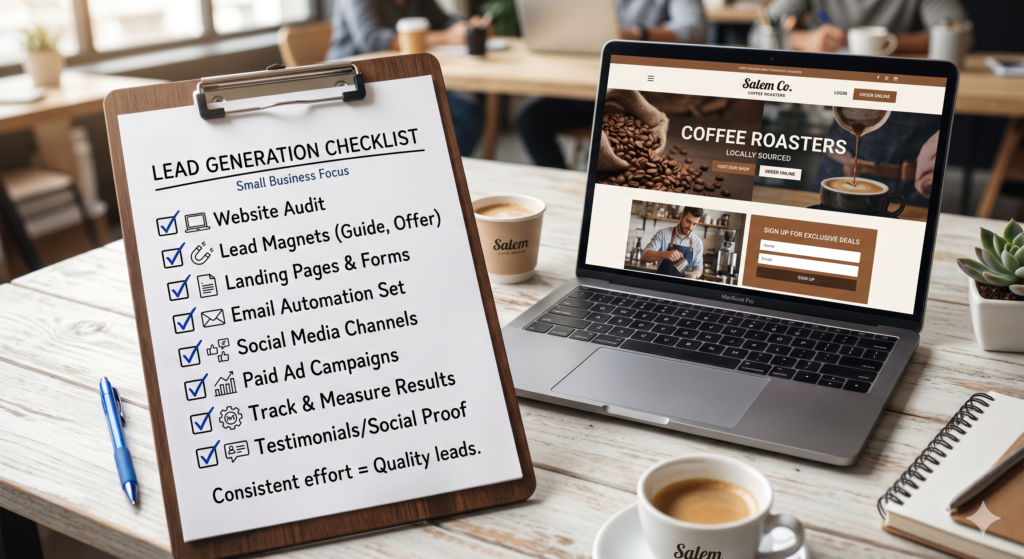
Work through this before making any changes or spending any budget.
✅ My homepage answers what I do, who I serve, and what to do next — all above the fold
✅ Every service page is over 800 words and ends with a specific, relevant call to action
✅ My contact form works and sends an immediate confirmation to anyone who submits it
✅ I follow up with new web inquiries within the same business day — every time
✅ My Google Business Profile is fully complete, verified, and has at least 10 reviews
✅ My website loads in under 3 seconds and works correctly on a mobile phone
✅ I have at least one blog post per month published consistently
✅ Every blog post links to at least one relevant service page with a clear CTA
✅ My business name, address, and phone number are identical everywhere online
✅ I track where my leads are coming from — form submissions, calls, and email inquiries
If you answered no to more than three of those, lead generation for small business is underperforming for your company — and the fix is clearer than you might think.
How Lead Generation for Small Business Connects to Your Bigger Marketing Picture
Lead generation for small business doesn’t operate in isolation. It’s the output of your SEO working to get you found, your content building the trust that makes someone want to reach out, your website structured to make reaching out easy, and your email follow-up system making sure no lead goes cold.
Each of those pieces reinforces the others. Better SEO means more qualified traffic. Better content means higher conversion rates from that traffic. A better website means more of those conversions result in contact. Better follow-up means more of those contacts become clients.
That’s what I mean when I say lead generation for small business is a system. When all the pieces connect and work together, leads compound. The businesses I’ve worked with that built this system properly don’t talk about lead generation the way they used to. They talk about which leads they want to take on — because they have enough of them to choose.
Ready to Build a Lead Generation System That Works?
If your website is getting traffic but not generating consistent inquiries — or if you’re relying on referrals and word of mouth because your digital presence isn’t pulling its weight — that’s a solvable problem.
The first step is understanding where your lead generation for small business is breaking down. Is it traffic? Is it the website itself? Is it the follow-up? In most cases it’s a combination — and identifying the right priority saves you from fixing the wrong thing first.
We offer a free website content audit for small businesses ready to stop guessing. We look at your traffic, your conversion structure, your content, and your local visibility — and tell you exactly what to fix first and why.
Or explore how our lead generation services and conversion rate optimization work together to build a lead generation system for your business from the ground up.
Frequently Asked Questions About Lead Generation for Small Business
What is lead generation for small business and why does it matter? Lead generation for small business is the process of attracting potential customers to your business and converting their interest into an inquiry, form submission, or phone call. It matters because referrals and word of mouth alone rarely produce the consistent, predictable lead flow a growing small business needs. A well-built lead generation system creates a steady pipeline of new opportunities that doesn’t depend on who happened to mention your name this week.
What is the most effective lead generation strategy for small business? The most effective lead generation for small business combines organic search visibility, a website built to convert, and consistent content that captures people at every stage of their decision process. For local service businesses specifically, a fully optimized Google Business Profile paired with locally focused content and a strong review profile is the fastest path to high-intent leads. There’s no single tactic — the system is what works.
How long does it take to see results from lead generation for small business? Timeline depends on which channels you prioritize. Google Business Profile optimization can show results in 30 to 60 days. SEO and content marketing build momentum over 3 to 6 months and compound significantly at the 12-month mark. Paid advertising can generate leads immediately but requires a properly converting website underneath to be cost-effective. Most small businesses see meaningful improvement in lead flow within 90 days when they fix their conversion foundation first.
Why is my website getting traffic but not generating leads? This is one of the most common lead generation problems I diagnose. Traffic without leads almost always means one of three things: the messaging on your website doesn’t clearly speak to your ideal customer’s problem, there’s no obvious call to action that tells visitors what to do next, or the pages visitors land on aren’t thorough enough to build the trust needed to make contact. According to research, 70% of small business websites lack a clear call to action on their homepage — which means most businesses are losing convertible traffic every single day.
Should a small business use paid ads or organic for lead generation? Both have a role, but the order matters. Organic lead generation for small business — SEO, content, and Google Business Profile — builds a compounding asset that keeps working without ongoing spend. Paid ads generate volume quickly but stop the moment you stop paying. The right approach for most small businesses is to build the organic foundation first, then use paid ads to amplify what’s already working. Running ads to a weak website burns budget without improving results.
How do I generate more leads without increasing my marketing budget? Lead generation for small business doesn’t always require more spend — it often requires fixing what you already have. Improving your call to action placement, expanding thin service pages, building out your Google Business Profile, asking satisfied clients for reviews, and publishing one consistent blog post per month are all high-return activities that require time, not necessarily more budget. Most small businesses have untapped lead generation potential in assets they already own.
What is conversion rate optimization and how does it help lead generation? Conversion rate optimization (CRO) is the process of improving your website so a higher percentage of visitors take the action you want — filling out a form, calling you, or booking a consultation. For lead generation for small business, CRO often has a higher immediate return than driving more traffic, because it makes the traffic you already have work harder. Improving a page that converts at 1% to 2% doubles your leads from that page without any additional traffic investment.
How important are Google reviews for lead generation? Google reviews are one of the strongest local lead generation signals available to a small business. They influence your ranking in Google’s map pack, they build trust with visitors who find you through search, and they signal to Google’s algorithm that your business is active and legitimate. According to BrightLocal, 87% of consumers read online reviews for local businesses before making a decision. For lead generation for small business that relies on local customers, reviews aren’t optional — they’re a core part of the system.
What should my homepage include for better lead generation? For lead generation for small business, your homepage needs to accomplish five things clearly and quickly: state exactly what you do, identify who you serve, explain what makes you different, show evidence of credibility, and provide a single prominent next step. That next step should be specific — not “learn more” but “request a free audit” or “schedule a call.” The more friction you remove from that first action, the higher your lead generation conversion rate will be.
Do I need a landing page or is my homepage enough for lead generation? Both serve different purposes in lead generation for small business. Your homepage is for all visitors — it needs to serve multiple types of people and move them toward the right service or next step. A dedicated landing page is built for one specific audience and one specific action, which is why landing pages consistently outperform homepages for campaign-specific lead generation. If you’re running paid ads or promoting a specific offer, a dedicated landing page will almost always produce a higher conversion rate than sending traffic to your homepage.


